Sunday, February 3, 2013

Reading Envy Halftime Report

Okay, okay, not really halftime, but I noticed that Scott has posted twice since I last posted!  Rather than post a single review, which always seems a bit redundant with GoodReads, I'm going to weigh in on a list I'm working through. I'm about halfway through reading the finalists for the 2013 Tournament of Books that the Morning News puts on in March.  I thought I'd offer my thoughts so far, and figure out what I still have left to read.  I'm copying the list with links directly from their site, but the reorganizing them into read and unread.

The 2013 Tournament of Books Finalists - Read (with reviews linked)

From the books I've read, I would say I enjoyed May We Be Forgiven and The Orphan Master's Son the most.  If Billy Lynn makes it on, I'd include it, much to my surprise.  My least favorite from what I've read is definitely the John Green, but it seems so very popular in book blogger land, so I'm happy to be in the minority there.

The 2013 Tournament of Books Finalists - Unread

To get my hands on Building Stories, I'd probably have to buy it, and I'm not sure I'll get a chance before March.  I have the Semple on hand, and will work on getting the rest.  I've heard the Flynn is great in audio, and I have just a few tracks of the Saunders' Tenth of December left before I'll be ready for another audiobook.  I'll purchase that next!

A Little More Than Halfway Through Space Magic

Space Magic by Devid D. LevineStories read:
Nucleon
I Hold My Father's Paws
Zauberschrift
Rewind
Fear of Widths
Brotherhood
Circle of Compassion
Tk'tk'tk, all by David D. Levine

A very short post today - it's Superbowl Sunday, which is a holiday in my family equal to Thanksgiving. We're driving an hour to a friend's house where we'll eat food, drink a beer or two, and watch the commercials. And there's a football game on, I think.

I had hoped to finish David D. Levine's collection called Space Magic this week. Even though I'm enjoying it very much, I didn't get it done. But I did read 8 of them (including a re-read of the Hugo winning "Tk'tk'tk"), which puts me right back on pace. Twenty so far this year. Full review of Space Magic next week!

In the meantime, enjoy my favorite Superbowl commercial EVER:


Sunday, January 27, 2013

Dealing with Entropy

Stories Read:
"The Dog Said Bow-Wow" by Michael Swanwick
"The Wind from a Dying Star" by David D. Levine
"The Guy with the Eyes" by Spider Robinson
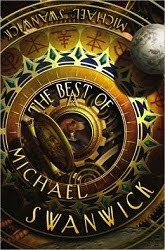
The Best of Michael SwanwickHow do I categorize "The Dog Said Bow-Wow" by Michael Swanwick? Steampunk with talking dogs? The story appears in an anthology called Re-wired: The Post-Cyberpunk Anthology, edited by James Patrick Kelly and John Kessel. So it's post-Cyberpunk... It also appears in an anthology called This is My Funniest: Leading Science Fiction Writers Present Their Funniest Stories Ever, edited by Mike Resnick, a book I clearly need to get my hands on. It is definitely funny.

The story takes place in a Victorian-like future, after a war between humans and artificial intelligences. The humans won. Sir Blackthorpe Ravenscairn de Plus Precieux (or "Surplus" for short) is a genetically engineered talking dog who, with his sidekick Darger, have a con in mind. Entertaining, funny, and very peculiar.

Space Magic by Devid D. Levine"The Wind from a Dying Star" is the first story in David D. Levine's collection called Space Magic. It's an interesting tale about some interstellar explorers that I thought were some kind of energy beings, but I found this note by Levine that tells me that the people in the story are "actually solid matter, a mix of biological and technological materials, though they use 'fields' to manipulate things and 'motivators' to get around." They are the further evolution of humans, actually, and I will read the story again in that context. I'll be reading the rest of this collection next week, hopefully, which hardly seems fair to Jenny! I received the eBook version of Space Magic to review over at LibraryThing as part of the Early Reviewers program, which makes me ridiculously happy.

Callahan's Crosstime SaloonHere's a quote I really like:
"Shared pain is lessened. Shared joy is increased. Thus do we refute entropy."
--Spider Robinson

That is a very short description of Spider Robinson's Callahan stories, and why I adore them. In world where we hear much bad news, these stories serve as a reminder of how we humans ought to treat each other. "The Guy with the Eyes" is the first Callahan story, published in Analog Science Fiction by Ben Bova in February, 1973. Callahan's Place is a bar where people bring their problems, and others are there to listen and share their pain. There are also puns. Ben Bova's Foreword in the paperback version of Callahan's Crosstime Saloon is called "Spider Robinson: The SF Writer as Empath". Indeed! Terrific stories. "The Guy with the Eyes" is five-star.

This puts me at 12 stories for the year so far. At this rate, I will reach only 168 and almost a half. I am pacing myself like Lance Armstrong in the Tour de France. Except without the drugs. Unless you count coffee as a drug, in which case I better schedule my interview with Oprah!

Friday, January 25, 2013

Book Beginnings: May We Be Forgiven by A.M. Homes


Book: May We Be Forgiven
Author: A. M. Homes
Why I am reading it: This is listed on the 2013 Tournament of Books, and I've been trying to read one of them each week. 

Beginning:
"Do you want my recipe for disaster?
The warning sign: last year, Thanksgiving at their house."
Impressions so far: I had read a book by A. M. Homes a few years back, The Safety of Objects, short stories that I enjoyed.  I'm enjoying this novel more (200 pages in), even though it uses a trope I usually hate - the depressed middle-aged academic ruining his own life.  I think where Homes seems to be succeeding where other authors have failed for me is that the situations and characters are more realistic.  Not everything is always terrible, even if the terrible things that have happened color every situation.  There are small moments of humor, but also moments where I feel very compassionately toward the characters.  That is no small feat, and I find this to be an engrossing read so far.

If you want to hear more about what I'm reading, friend me on GoodReads. Thanks for stopping by!

Thursday, January 24, 2013

Snow by Orhan Pamuk

Country: Turkey (3 of 52 for 2013)
Baked Good: Spinach-feta börek

SnowSnow by Orhan Pamuk
My rating: 3 of 5 stars
Why I picked this book: First pick of the year for the World's Literature Group in GoodReads. Plus I have always wanted to visit Turkey, and had this book on my shelf for a year.

Ka, a poet exiled from Turkey, returns to his home country to write about a series of young girls who have been committing suicide in the city of Kars. At least, that is the reason given at the beginning. It gets more complicated once you find out that a woman he has loved also lives there, and is recently divorced.

I was interested in the story of Snow, and of the imagery (how snow masks violence, how snow can be isolating, the uniqueness of snowflakes - these are repeated themes). I was particularly interested in the poems, but the reader never gets to read them. While the narrative gives a good excuse in the end, I was unable to let go of my disappointment over being denied such a central element of the story. There are frequent comments about how poets separate themselves from what is going on, to preserve their hearts and to let the poems come to them through events, such as here:
"Ka had explained to me that when a good poet is confronted with difficult facts that he knows to be true but also inimical to poetry, he has no choice but to flee to the margins; it was, he said, this very retreat that allowed him to hear the hidden music that is the source of all art."
But since we don't see inside of the poems, it suffices to separate the reader from Ka's true emotions and feelings about almost everything.

The other issue that interfered with my enjoyment of the story is the narrator. It is a friend of Ka's who is telling about Ka's journey, recreated through journals, newspaper articles, and interviews. This isn't immediately apparent, but isn't a spoiler to say so, I don't think. Because of this tactic though, it removes the reader even farther from the central emotion of the story. I had also guessed at one event that I suspect was supposed to be a great reveal, although the narrator frequently stumbles over himself to tell the juicy bits of a story, forcing him to go back and try to put it into context. Amusing, yes. Frustrating, also yes.

Another element I struggled with was the reaction to violence. The director of the Institute of Education is killed in front of Ka and Ipek, and while they leave the cafe rapidly, there isn't a sense of danger. Neither is there a sense of fear when people are killed by revolutionaries in public. That didn't seem true to life, and I think I'll blame the unreliable narrator. I get that Ka was putting his emotion into his poetry (which we never see), but what about everyone else living in Kars? Why go to a theater where there was violence at the last performance in that space, only to experience violence again? I will allow that I may not be reading between the lines enough, or that the narrator is glossing over the details most people would give. It made it very hard to connect to.

Other little bits on writing and poetry and happiness:

"Only people who are very intelligent and very unhappy can write good poems. So you heroically undertook to endure the pains of faithlessness, just to be able to write good poems. But you didn't realize then that when you lost that voice inside you, you'd end up all alone in an empty universe."

"But doesn't life make us unhappy?"
"We do that to ourselves."

"Only the purest poets allow love into their hearts in time of revolution."

View all my reviews


Monday, January 21, 2013

The Best of All Possible Worlds by Karen Lord

The Best of All Possible WorldsThe Best of All Possible Worlds by Karen Lord
My rating: 5 of 5 stars
Why I read it: I enjoyed her last book, and jumped at the chance to read this before it came out through NetGalley.

I do not give out five stars lightly, but there are several reasons why I think Karen Lord's novel deserves it. This is pure science fiction, which was a surprise after reading her previous novel, Redemption in Indigo, which while enjoyable was a retold myth or fable. Since Karen Lord is one of three Caribbean authors writing in science fiction and fantasy, I have been looking forward to seeing what she would do next.

I have reamed novels set in space when they trade scientific description for unrealistic character portrayals. I would say that creating nuanced and interesting alien races is her strength. It isn't all science, as all the races have a slightly vague, mythological history. Are the Caretakers real? What is the connection between Terrans and the Sadiri?

The two main characters are Dllenahkh, who is in charge of Sadiri refugees, and Delarua, who accompanies him on a mission because of her scientific and language ability. Karen Lord was inspired by the statistics of how many more women than men were killed in the 2004 tsunami, and applies that idea to the disaster that makes the Sardiri into refugees. To further their culture, they have to go look for societies that may have ancient connections to their own, little pockets of taSadiri throughout the universe. Because of this, the author explores genetic mutation between alien races, and what remains of an original culture.

I felt the alien races were well-developed, and I liked the concepts of Sadiri communication, and the examples of people who have abused their natural abilities. There is a good balance of interpersonal conflict alongside broader issues. I feel like anyone who likes Melville's Embassytown because of the anthropological challenges but prefers their novels to be more readable, and anyone who enjoys the space novels of Ursula K. Le Guin, will connect with this novel.

Highly recommended.

View all my reviews

Arcadia by Lauren Groff

State: New York (Upstate) - 3 of 52
Baked good: Raw citrus cheesecake

ArcadiaArcadia by Lauren Groff
My rating: 3 of 5 stars
Why I read it: I've had this on my to-read list for a while, but the fact that it was listed on the Tournament of Books pushed me into moving it up on the list.

As a librarian, one of the worst sins to encounter in writing is using someone else's work without crediting it. Groff has some very poetic language in parts of this book, an element of the novel that many reviewers keep mentioning as one of the good parts. Too bad it isn't always hers. She must have used the "center cannot hold" at least twice, it may have been three times. A nice concept. I think Yeats thought so too, when he wrote it. There are multiple moments like this that took me out of the story in annoyance, not just Yeats.

That said, I'm a sucker for a commune story. I went through a phase of reading novels, memoirs, and studies of communal societies, and have visited several in the United States - New Harmony, IN; Amana, IA; the Shaker Village in Pleasantburg, KY.... it is something that will always be interesting to me. The novel focuses on four stages of Bit, a child born to wandering hippies just as approach property inherited by one of their members in upstate New York. First his young childhood, then his early teen years as the commune predictably falls apart, then his life as a new father in Manhattan, right after the towers fall, and then with his aging parents.

I enjoyed the details of Arcadia - the floury air from baking their own bread, the soy-everything diet, the unwashed bodies, the failed attempts at democracy. It was easy to picture, and I was grateful for the lack of religious undertones for once. I feel like the author took the easy way out in having a central male leader figure, but perhaps some things are stereotypes because they are true. In that case, she is forgiven for the pot as well.

The last section of the four, trying to portray a world facing down pending disaster of spreading disease, was her least believable story. The irony is that it gives a weight to the importance of living off the land, while having shown how difficult it is to make an alternate society work in the long-term.

View all my reviews