- March 18 - Hill William v. How to Get Filthy Rich in Rising Asia(My round is different since I picked Asia and the judge picked A Tale for the Time Being) - I think these are about even, but I guess I'll pick Hill William.
- March 19 - The Good Lord Bird v. The Signature of All ThingsWell I never read Bird so I'll go with Signature.
- March 20 - Eleanor & Park v. The SonEleanor & Park was wonderful, and The Son is so full of violence I may never even try it. E&P!
- March 21 - Long Division v. The People in the TreesI had selected Long Division rather than The Goldfinch. It had some issues and while I am looking forward to the author's next book, The People in the Trees is the best book in the tournament in my opinion, so it wins. And it will keep winning. Um, spoiler alert.
Thursday, March 20, 2014
Tournament of Books - this week's votes
I feel like I've already discussed the books, and since I'm still me, there's not a lot more to say. So I'll just post who I would pick for each round this week!

Monday, March 17, 2014
Tournament of Books: Atkinson vs. Yanagihara
I'm playing along with the Tournament of Books!
Today's book match:
Today's book match:
Life After Life v. The People in the Trees
 
|
vs. |  
|
I do not envy John Green his decision as the official Tournament of Books judge for this round. I think these two books are the strongest in the tournament. The two novels are very different, but have some interesting similarities in the way truth changes based on who is telling a story, how history can change (literally in the Atkinson), and how perspective can be everything.
I have already <a href="http://readingenvy.blogspot.com/2014/03/tournament-of-books-life-after-life-vs.html">discussed Life After Life</a> in the pre-tournament round, so I won't repeat myself.
The People in the Trees, on the other hand, is probably the book I have been the most conflicted about in my entire life. It's written like an annotated memoir based on letters from jail, about a scientist who does research on immortality on a newly discovered Micronesian tribe. So the style is cool, you would almost think it was real non-fiction but its all fiction and therefore a novel. I even got tricked a few times into looking up books that are mentioned. They don't exist. Nothing is real. But throughout the reading of the book, I would forget and indulge my librarian side..
The scientist, Dr. Perina, is really unlikeable. You know at the beginning that he is in jail for abusing his children, but you don't know the story or if it's true until the end.
Along the way though, along with imaginative jungle descriptions and tribal culture, are pretty explicit scenes of violent sexual abuse. The author made them central to the plot. I ended the novel feeling like I'd witnessed something awful, something that since it didn't even happen, I never needed to have read, so unnecessary.
So okay my question is this... Is this brilliance, If I'm shaken to the core? Or was I just manipulated? Could it have had the same emotional impact without those scenes or if she'd implied them? Either way the author willingly put it there. I think I hated it yet feel like I was supposed to.
I brought the book up to several trusted book groups and readers, asking their opinion about what it MEANS when you react this way. I still haven't rated the book in GoodReads. I'm not sure I'd recommend anyone to read it, but I secretly think it might be brilliant. So the winner I will choose is People in the Trees.
ETA: See John Green's official choice as judge for the Tournament of Books.
Sunday, March 16, 2014
Visiting the history of a place: The Invention of Wings by Sue Monk Kidd
 The Invention of Wings by Sue Monk Kidd
My rating: 5 of 5 stars
(I received a copy of this from NetGalley in exchange for an honest review.)
This book by Sue Monk Kidd is a story based on Sarah Grimke, an early Charlestonian abolitionist. It is told by alternating chapters from Sarah's perspective (starting from childhood), and of her personal slave Handful. While some of the story is imagined, much of it comes from the history of the Grimkes, pre Civil War Charleston, and the slave rebellions of the time.
I was excited to get a copy of this book because I was heading back to Savannah and Charleston for Spring Break. Little did I know that I would encounter details from the novel in my tourism! I spent part of a day at the Boone Hall Plantation, one of the handful of plantations that can be toured along the rivers and marshes in Charleston. In the row of slave houses, where each one focuses on a different era in slavery, abolition, and advances for African Americans in the south, I found pictures and bios of the Grimke sisters, Denmark Vessey (an important figure in the novel), and even a representative quilt similar to the one created by Handful and her mother. I know the author lives in the area, and while she did not specifically mention Boone Hall, the world of The Invention of Wings felt very alive in that moment.
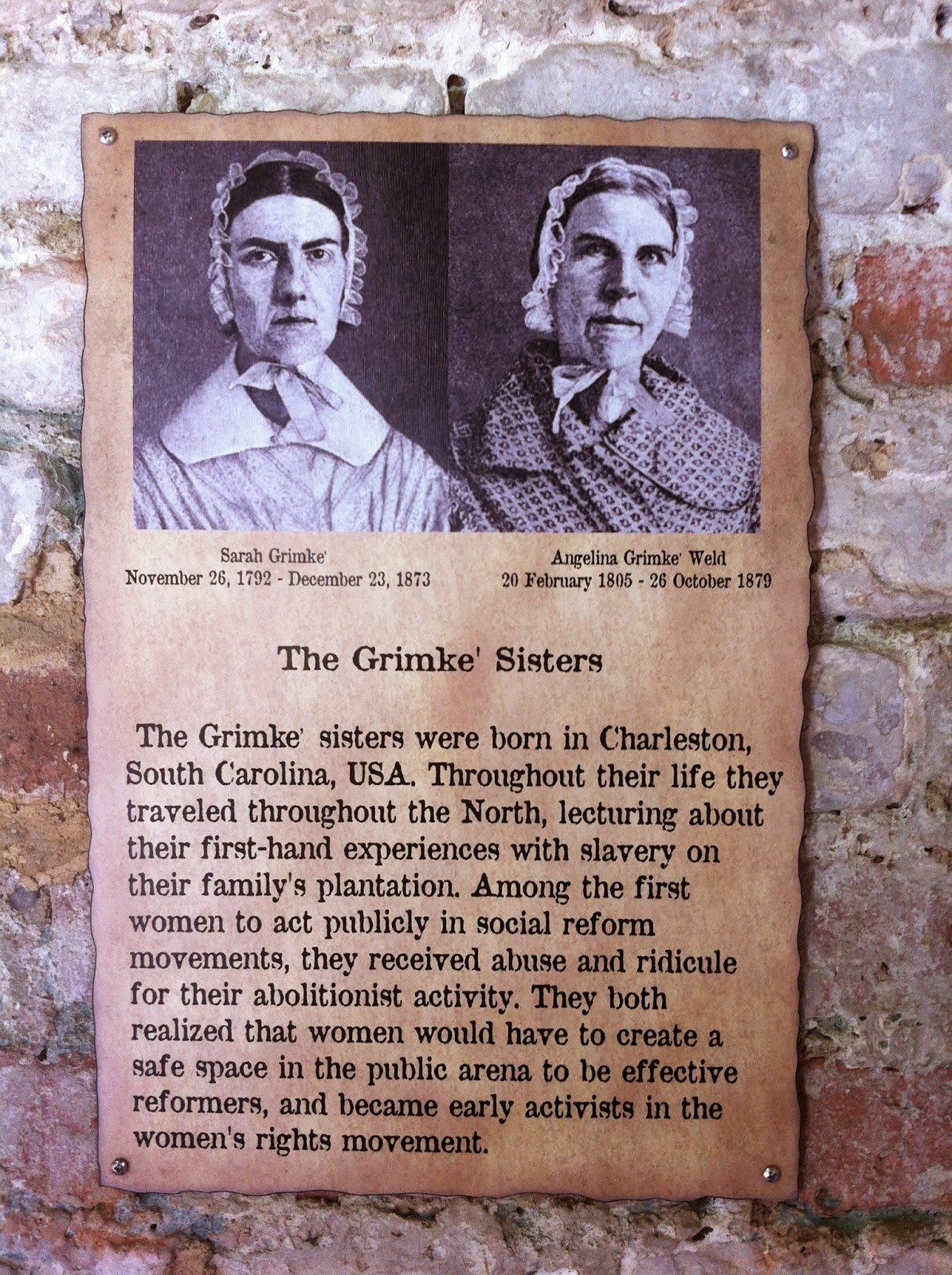
People who lead change have a rough road. What I liked about this novel was that it wasn't just about the conviction of a rich southern child, but the difficult journey. From the beginning of the novel, Sarah is denied access to the world of learning, with her father banning her from his library after she taught Handful how to read.
"'The truth,' she said, 'is that every girl must have ambition knocked out of her for her own good. You are unusual only in your determination to fight what is inevitable. You resisted and so it came to this, to being broken like a horse.'"
Sarah Grimke ending up speaking for the rights of women alongside the abolition of slavery, a move that ostracized her from communities like the northern abolitionists and Quakers. She was forbidden to return home, as was her sister Angelina. They would only live long enough to see the tough times of the Reconstruction Era, but not the long-reaching impact they had in both areas of human rights. Kidd does an excellent job of telling their story in a way alongside the often overlooked story of the larger slave community, not just on one plantation but Charleston-wide, where slaves outnumbered white people at incredible numbers.
 |
| Slave Row at Boone Hall Plantation |
Saturday, March 15, 2014
Library Books Mid-March Edition

This weekend I will be reading Americanah by Chimamanda Ngozi Adichie, all 477 pages of it, because my only in-person book club meets Monday evening to discuss it. I was not planning to read this book, not because I don't enjoy Adichie (I do!) but because I have read multiple books set in Nigeria and want to expand my African horizons if I spend time reading authors from that continent. As of this writing I have pushed through 100 pages, and it is good, but it is not the book I'm in the mood to read.
Dreams in a Time of War, The Sand Child, and Dead Aid are all from my Great African Reads group in GoodReads. I don't tend to read along with every selection, so I will probably try these out and only read what grabs me. Dead Aid is non-fiction and short, and might be interesting. Altered Carbon is this month's pick for the Sword and Laser group, and it has been a while since I've read along. I started that book and liked it but it was getting mixed up in my head with the audiobook I was listening to at the time, so I put it aside for later.
How to Get Filthy Rich in Rising Asia was the last book I read for the Tournament of Books, and I already discussed it earlier this week.
The book on the top of the pile, Palimpsest, is actually one of my favorite books from one of my favorite authors, Catherynne M. Valente. I loaned my paper copy to a former student and I was thinking about how much I love the language, and thought it might be nice to hear in audio. On a whim I searched the catalog of my local library and voila!
The last two books are not Shoulds but I have not yet tried them. We Are All Completely Beside Ourselves is a book I've been circling for a while, thinking about checking it out, knowing I have enjoyed previous books of her stories (What I Didn't See.) Then a friend e-mailed me to reassert that I should definitely read it, and I checked it out. Ironically I'm not reading it because it is on the list of Nebula nominees, as I'm not pushing myself to read everything Nebula and Hugo as I have done in years past. Nearby I found the Diaries of George Orwell, and I just couldn't help myself. I hope they are slightly paranoid and obsessive or I will be disappointed!
Friday, March 14, 2014
Tournament of Books: The Goldfinch v. Long Division
 
|
vs. |  
|
Kiese Laymon was a new author to me before the Tournament of Books, while Donna Tartt was a definite known entity with books like The Secret History and The Little Friend.
Neither book is perfect. The Goldfinch spends almost 600 pages being a literary thriller and then attempts redemption in the end by being insightful and "deep," but I felt like the ending was the least successful part. There is no shame to a well-written literary thriller! I also felt like the main character was difficult - he isn't a good person, but he's had a hard life. Tartt does an excellent job of making him complicated and imperfect, where I wasn't sure if I wanted him to succeed or not!
In Long Division, I loved the characters absolutely, particularly Citoyen "City" Coldson, the 14 year old who becomes internet-famous overnight. The basic framework of his story with time travel didn't always have the consistency I need in a good time travel book. I would have been just as happy living with the characters in one decade or another, in other words I think the author was compelled to stretch the boundaries of the world his characters lived in, but they didn't need it. He had created a solid story as it was.
This is a hard round to call, because the books are so different. I guess it comes down to which author would I pick up to read again, the one I look forward to the most, and I think my answer to this leads me to select: Long Division by Kiese Laymon as the winner for this round.
See official judge Héctor Tobar's verdict at the Tournament of Books site.
Thursday, March 13, 2014
Tournament of Books - Skipping this Round
I'm playing along with the Tournament of Books!
Today's book match:
Today's book match:
The Son
v. At Night We Walk in Circles
 
|
vs. |  
|
I shamefully did not read either of these books. I gave the Alarcon 50 pages but didn't finish, and The Son never became available at the library. This one is a draw!
ETA: You can read the opinion of official judge John McElwee and his verdict at the Tournament of Books site.
Wednesday, March 12, 2014
Tournament of Books: Lahiri vs. Rowell
 
|
vs. |  
|
The Lowland is a story about a man whose brother dies, and he marries his brother's widow and moves to Rhode Island while he attends school. It is a familiar type of story for Lahiri, but to me, not as emotionally connected with the characters (neither with each other or with the reader) as previous books such as The Namesake.
Emotional connection. That all important bond between reader and author. One of the education professors where I work said it better than I ever could in his review of Eleanor & Park, because he connected on such a deep level with the novel. I can't imagine anyone ever having such a strong connection with The Lowland. It simply isn't there.
I loved Eleanor & Park because it took me back to high school - the long bus rides, convincing the people who intimidated me that I did not care what people thought, enduring comments on my appearance and feeling awkward - Rainbow Rowell doesn't shy away from any of it.
I can't believe the book has been as heavily censored as it has been; honestly I didn't even notice any profanity or overt sexual content if it was even there because it's all written so realistically. Librarians are compelled to fight censorship, so I connected with it on two levels - shared experience and protective librarian! There's just no contest, this round goes to: Eleanor & Park.
ETA: See the opinion of official judge Jami Attenberg at the Tournament of Books site.
Subscribe to:
Posts (Atom)