Tuesday, August 9, 2011

Reading Ulysses, 25% in

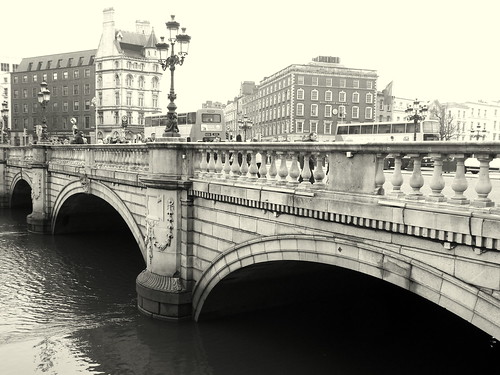
(photo courtesy of uggboy on Flickr)

I've been on a bit of an extended weekend and have only done piece-meal listening, but finally made it about a quarter in, which means I'm just about finished with Chapter Eight: Lestrygonians.

So far I have followed Leopold Bloom to the butcher, to the outhouse, to the post office, reading a letter from an erotic penpal of sorts (to a pen name), to a funeral, to a newspaper office, to a bar, across a bridge, and so on. It is pretty funny because since so much of what Joyce wrote is stream of consciousness writing, the activities and dialogue of the characters is interspersed with Bloom's constant internal dialogue, including his distraction by attractive women, fretting about his wife's potential dalliances, his daughter's boyfriend, his mother's death, and so on.

The audio started getting confusing around the time of the carriage ride to the funeral, and I had to go back and look at some character lists. I should have the readers guides in-hand tomorrow, which will help a lot too! Simon Dedalus is Stephen's father, and I don't think it was happenstance that Dedalus Sr. and Bloom share a carriage ride, so they must be connected in some way. There is a long conversation about death, as is expected when heading to a funeral.

Bloom thinks about death more later on. He runs into an old flame who tells him about a woman who has been hospitalized for a difficult birth. He was handed an evangelical tract along the way, and his thoughts go in circles being "washed in the blood" and the cycle of death and life, particularly since back then so many women and children died in or around childbirth. His own son only lived a few days.

I left Bloom eating a cheese sandwich.

Little tidbits I liked:

-The headlines interspersing the story in chapter.. 7, or 6, hard to tell with the audio. "Onehandled adulterer" gets repeated several times.

-When Bloom is contemplating who can own the river, Joyce throws in another poetic description of water, which he seems to love.
"His eyes sought answer from the river and saw a rowboat rock at anchor on the treacly swells lazily its plastered board."

-At one point he is thinking about what would catch someone's eye in an advertisement, and says
"Smart girls writing something catch the eye at once. Everyone dying to know what she's writing."
I liked that for different reasons, since some of my friends are still writing real letters, but it also points to how women keep showing up in his thoughts.

-Random funny bit:
"Mayonnaise I poured on the plums thinking it was custard."
I lost track of why/how that came up. Plums come up multiple times though. Do they mean something? This is one idea I'll look up in the companion books!

Friday, August 5, 2011

Reading Ulysses, Day 2

Full disclosure - I've been reading a bit of information outside of Ulysses just to understand what is going on, and I downloaded the free Kindle version so that I could go back and re-read bits that stuck out and quote them correctly.

I mentioned before that the only Joyce I had made it all the way through previously was A Portrait of the Artist as a Young Man, and the very first part of Ulysses actually features the same character, and was published four years after Portrait, although I'm not sure how much time has passed to Stephan Dedalus. The first three chapters of Ulysses are referred to as the Telemachiad, and chronicle Dedalus with his friend Buck Mulligan, and then follow Dedalus as he teaches, meets with an advisor, and then one long chapter where he's just ... thinking. Stream of consciousness, in multiple languages. I'm not going to lie and say that was easy to follow!

Part of the problem for me as far as reading comprehension is that Joyce wrote this as a parallel to the original Odyssey. Have I ever read that? I remember doing group projects having to do with the Odyssey in seventh grade, including a really fun radio play version that my group wrote and performed, but that was the last time I read anything close to the Odyssey. That would have been twenty years ago. I'm worried that I'll miss the connections, that I won't "appreciate" it as it was meant to be understood, but I'm just letting that go and trying to enjoy what I can.

There are a few bits of the Telemachiad that stuck out to me, which I will reproduce here:

Some of the language is descriptive, in a way that only young men could make it.
"A great sweet mother? The snotgreen sea. The scrotumtightening sea." (Mulligan talking about the ocean to Dedalus).

"History, Stephen said, is a nightmare from which I am trying to awake."
(To Mr. Deasy)

"To learn one must be humble. But life is the great teacher."
(Mr. Deasy to Stephen)

"Reading two pages apiece of seven books every night, eh? I was young. You bowed to yourself in the mirror, stepping forward to applause earnestly, striking face. Hurray for the Goddamned idiot! Hray! No-one saw: tell no-one. Books you were going to write with letters for titles. Have you read his F? O yes, but I prefer Q. Yes, but W is wonderful. O yes, W..."
This last one is a good example of the Dedalus stream of consciousness that goes on for a while, but also made me laugh and think of C by Tom McCarthy, and I wonder if he chose it because of this passage (especially considering that most of his novel is a shoutout to other novels).

After the last chapter of the Telemachiad, the novel practically restarts and begins the morning with Leopold Bloom. I have more questions than answers at this point. Is there a connection between Bloom and Dedalus? Why bother with Dedalus at all?

I suppose I may find this out eventually. For now, I will content myself to hear about Bloom's breakfast preparations and toilet ruminations, which is how I last left off.

Thursday, August 4, 2011

Reading Ulysses, Day 1

Ulysses
I'm sure all of us have mighty tomes we haven't yet read. I've tackled Moby Dick, Les Miserables, and Anna Karenina, but there are still a few I want to get to.

War and Peace is definitely on the list for someday, although I start trying to work up to it from time to time and the translations of the Russian naming conventions just does me in, so I haven't yet faced it. Add to that not knowing much about Russian history, and I worry that I wouldn't get all the context. Infinite Jest is still sitting on my shelf at home. I don't think I've even cracked the binding. One of my favorite reader friends keeps telling me all these other post-modern titles I need to read "first." I've been scared away!

One book that I've started several times is Ulysses (Oxford World's Classics). I read A Portrait of the Artist as a Young Man in high school, but the rest of Joyce has eluded me. Ulysses has to be the book I've started and put aside the most often. I know it has greatness inside it. Any review I've read by people who have made it through praise it up and down. The only time I made any progress at all was when I read it out loud; something about the flow of the language just demands it. The only problem with that strategy is that I often read while I'm around other people, and I'm not sure they would appreciate this practice.

Last night I finished listening to Wizard and Glass (The Dark Tower, Book 4) and went looking for a new audiobook to listen to. I usually listen while I'm driving or cooking, any time where I can devote most of my brain power to just absorbing what I'm hearing. The reviews of the next Dark Tower book were mixed on the audio - the original reader had been in a bad accident and someone else took over, and a lot of people were saying it was better to read the print. I'm one of those people who might choose an audiobook based on the reader, so I wasn't about to listen to one that people who prefer to listen didn't like! I searched and searched, through Overdrive and Audible, for something that really reached out and grabbed me, but I wasn't finding much. (I was hoping for the Talented Mr. Ripley books, since I so enjoyed the Highsmith short stories in audio, but they don't seem to exist).

I started thinking about books that take well to audio, and about accents, and stumbled across two versions of Ulysses. Longer books really make Audible.com credits worth while, because the CDs for them might cost around $100, but the entire book was only 1 Audible credit. There were two versions to choose from, and I listened to previews of both and tried reading reviews of both, but in Amazon, they group all editions of a book together, making it impossible to link a specific review to a specific reader (this is such a bad practice, it hurts my librarian heart). I ended up going with the version read by John Lee, because one Audible review said it used the more accepted version of the book (whatever that means, ha!), and his voice was a little easier to listen to. I'm not sure if that will hold out for the long haul, and one reviewer actually said they thought the experience was better at 60% speed, actually slowing down the voice to allow your brain to process the accent and the words.

Right now I'm listening at real-time speed, and we'll see how that goes. I have only gotten about ten minutes in (you can blame my short commute), but already am enjoying the dynamics between the characters and the description of the landscape. This will be a thirty hour listening commitment, so I will give updates from time to time.

Friday, July 29, 2011

Rating System

Amanda, over on the Dead White Guys blog, just posted asking about how people rated books. I'm copying and pasting my comment here, because I'm pretty sure everyone rates books differently. Just like the teacher who hands out As on a rare occasion, my 5 star rating is reserved for something special.

In GoodReads, here is how I have it divided:
5 stars - amazing, life-changing, I will buy a copy if I don't own it
4 stars - solid, good book, might even read again someday
3 stars - okay but not my style, or it didn't live up to the hype
2 stars - just not great, nothing special
1 star - surprised I finished it, a disappointment

What isn't really included here is the way I feel about the rare book I give 5 stars to. It is the book I finish and immediately reread the first bit because I don't want it to be over, or will write fan mail to the author, or stop and read parts out loud because I want to hear them, or literally clasp the book to my chest and take breaks because I want to make it last. That, and only that, is a five-star book.

Tuesday, July 26, 2011

Man Booker Prize 2011 Longlist Announced

The longlist for the 2011 Man Booker Prize was announced today. I am not ashamed to admit that I do not recognize any of the authors, which means I will learn a great deal as I read through the nominees. Four of the nominees are first-time novelists, according to the news release, so it will be interesting if any of them make it to the shortlist. Three of the thirteen won't be available in the USA by the time the shortlist is announced, and one isn't even listed in Amazon.com yet.

Julian Barnes - The Sense of an Ending (Jonathan Cape - Random House)
This title won't be available stateside until January 2012

Sebastian Barry - On Canaan's Side (Faber)
This title comes out in the states September 8, 2011

Carol Birch - Jamrach's Menagerie (Canongate Books)

Patrick Dewitt - The Sisters Brothers (Granta)

Esi Edugyan - Half Blood Blues (Serpent's Tail - Profile)

Yvvette Edwards - A Cupboard Full of Coats (Oneworld)

Alan Hollinghurst - The Stranger's Child (Picador - Pan Macmillan)
This comes out October 11, 2011

Stephen Kelman - Pigeon English (Bloomsbury)
Just released last week!

Patrick McGuinness - The Last Hundred Days (Seren Books)
Not even listed in Amazon.com yet

A.D. Miller - Snowdrops (Atlantic)

Alison Pick - Far to Go (Headline Review)

Jane Rogers - The Testament of Jessie Lamb (Sandstone Press)

D.J. Taylor- Derby Day (Chatto & Windus - Random House)

I'm starting with The Testament of Jessie Lamb, because it sounded right up my alley based on the descriptions.

Trying to read all the nominees for certain awards is an insanity I started taking on last year. I've also gone back and read a lot of the past winners. My Booker Prize Bookshelf in GoodReads is a mixture of older prize winners and more recent long and shortlisted titles, so feel free to go read my old reviews if you are interested. I can easily say that the two I've enjoyed the most are C by Tom McCarthy and How Late It Was, How Late: A Novel by James Kelman.

Short Stories - St. Lucy's Home for Girls Raised by Wolves; American Salvage

I have been on a short story kick lately. I think when some people go toward light reads during the summer, I go for brevity. Blame lack of attention span, or just a desire to absorb as much as possible - whatever it is, short stories seem to do the trick! Anyone who reads a lot of short stories knows that they aren't always light. In fact, it is an opportunity for a writer to show us just how good they are at their craft, and they have less space to do so. Two authors recently have really wowed me for completely different reasons.

St. Lucy's Home for Girls Raised by Wolves: Stories
St. Lucy's Home for Girls Raised by Wolves

Sunday, July 10, 2011

Reading Poetry

I remember sitting in the AP American History/English Block class I took my junior year of high school, not even trying to contain my skepticism over the symbolism Mrs. Aragon was berating me for not understanding in a poem. I remember thinking - if it is so obvious, why am I not getting it? And what if I see something differently from the teacher? Did each poem get written with some kind of key or legend that students just weren't given (and if so, where could I get my copy)? Understanding the poems of early Americans came with a certain amount of ire, and, well, boredom. As much as I love violets, I still would rather hike through the woods on my own and come across one than read another word of Wordsworth or Longfellow trying to describe them to me.

For a long time, poetry and I - we were through. It felt entirely too academic, and too saturated in historical and mythological references that I never thought I'd entirely grasp. Nobody had to know that I never read any.

At the same time, I have always paid great attention to song lyrics. Sometimes I like songs because of the words, forget the music part. Somehow I had created a mystical divide between song lyrics and poetry, thinking poetry was something dry and academic while song lyrics could be emotional and personal. I'm not sure where the desire to read poetry came back.... somewhere around the time I read The Anthologist and when I started writing for my own entertainment during National Novel Writing Month.

I started devouring poetry again, often reading the collected works of a poet. Mark Strand. Carl Sandburg. The Black Mountain poets. Mina Loy. Emily Dickinson. There wasn't any rhyme or reason to it, but for some of it, I did use the poets mentioned in Baker's book (which I obsessively created an index to). And I found that I could almost always find a poem or two that I really connected with, that touched me on a deep level. It seemed worth it to me, so poetry and I are back on, tentatively.

Without tests to take, without well-meaning teachers instructing me as to the meaning of a poem, here's how I think about it.

1. I skim a volume first. If I'm not finding little tidbits that I resonate with, I put it aside. I am even pickier about poetry than I am about novels. I don't usually care to read long-form poems (although some have won me over, Ginsberg) or dedication poems, and frequently am turned off by poems inspired by art, war re-enactments, or flowers. What is that, 80% of poetry? 90%?

2. If it something I'm feeling into, I skim, then I go back and read more carefully. I find a poem can rarely be fully appreciated in one sitting or one time through.

3. Once I find one I really like, I often read it out loud. It just seems that poetry should be heard, even in my own voice. The last volume of Margaret Atwood poems I read, The Door, included a CD with the poet reading some of her writing, which was a huge asset.

Who is your favorite poet? Do you have anything to recommend to me?