Monday, December 26, 2011

Appassionata by Eva Hoffman

AppassionataAppassionata by Eva Hoffman
My rating: 4 of 5 stars

This book is more of the 4.5 stars variety for me. The story is about Isabel Merton, a concert pianist, who ends up in a relationship with a man involved in the politics of volatile Chechnya. The amazing part of the novel isn't the story, but how the writer has capture the emotions of music in words. There are portions where various thoughts of people attending Isabel's concerts are written in streams overlaying each other, as well as Isabel's own thoughts while she plays and I wanted to shout, "Yes! This is what it is like!" So few people know, and fewer can explain, and Hoffman has.

The book has no chapters, but there are sections of Isabel preparing for concerts in various cities, interspersed with sporadic sections of her in the "in between" (usually while traveling) where she reads the journal of one of her former teachers. There is also the story of her childhood, particularly of her brother, which has a clear impact on her own life and outlook. Because there is no pause, no end, I found it difficult to stop reading, and wanting to start from the beginning when I came back to it. In fact, that would have been an homage to my own piano training, my own teacher who would announce "Again!" after any little error.

Beyond the writing about music, which I connected fully with, is a commentary on what revolution, war, terrorism, and violence mean to us in our current society. Do we take it seriously enough? Does it even matter to us? Do we diminish it or ignore it? Do we take responsibility for our own part? The novel does an interesting job of asking the questions and demonstrating several different answers in the perspectives and actions of several of the characters.

Saturday, December 24, 2011

Go-Go Girls of the Apocalypse by Victor Gischler

Go-Go Girls of the ApocalypseGo-Go Girls of the Apocalypse by Victor Gischler
My rating: 3 of 5 stars

If a post-apocalyptic book can be funny, this is it!

Basic summary: The world has been over for nine years, and Mortimer has been cozy and safe, protected in a mountain fortress he bought for himself when he saw the end coming. But he gets bored and decides to wander, and finds that the former United States is still in chaos, but a chain of strip clubs have started to be the center of new communities. Then he decides to look for his wife....

This is a quick read, full of blood and guts and strippers. Oh and cannibals. And steam power. Just a little bit of everything, really.  Just the thing for down time on Christmas Eve....

Thursday, December 22, 2011

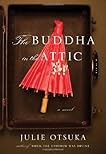
The Buddha in the Attic by Julie Otsuka

The Buddha in the AtticThe Buddha in the Attic by Julie Otsuka
My rating: 2 of 5 stars

I first found out about this book when it was named a finalist for the National Book Award.  When I first read the Kindle preview of this, I decided I probably wouldn't like it because it felt like a "book club book," meaning a little light for my tastes. Having actually sat down and read it, I still dislike it, but for different reasons.

The second sentence of the novel: "We had long black hair and flat wide feet and we were not very tall." This voice is not just for the set-up of the book, like I'd originally thought. No. Throughout the entire novel, Otsuka maintains this impersonal "we," referring to the Japanese women who move to the United States in the late 19th/early 20th century to marry men they've never met. The focus of the book shifts from "Come, Japanese" to "First Night" to "Babies" to "The Children" and so on, ending with all the Japanese in the area being round up and sent to Japanese internment camps during WWII.

It feels more like an epic poem. The entire time I was picturing someone reading these lines, intoning them low and serious, like the backdrop of a religious ceremony. As of such there isn't really a plot, per se. The reader never gets to know one person's story from another, everything is just a list of things that happen, but it is always to "we" or "one of us" and you can't follow anyone's story all the way through. It is almost as if Otsuka, in wanting to tell these womens' stories, diminishes their lives even further.

Sunday, December 18, 2011

The Best Books of 2011

On Wednesday, I said I was tempted to compile all the lists of lists of the best books of 2011 into one list, then sort it by popularity.  I couldn't resist!  Here are the top 12 books of 2011, as determined by everyone in the English speaking universe.  If you look at the list of lists put together by Random House, I used every list except those that were over 50 books (come on people, that isn't selecting anything!) or those that were genre-specific.  Those that were broadly fiction or non-fiction were included.

A few comments on the list - quite a few of these are first novels.  Harbach, Obreht, Wilson, Morgenstern, Waldman, and Russell; congratulations to those authors for really achieving something special.  I just bought a copy of The Tiger's Wife at the Hub City Bookshop in Spartanburg, SC, and it is the #3 book of 2011.

Book Author # of mentions
Art of Fielding, The Harbach, Chad 10
Marriage Plot, The Eugenides, Jeffrey 10
Tiger's Wife, The Obreht, Tea 9
1Q84 Murakami, Haruki 8
State of Wonder Patchett, Ann 7
Open City Cole, Teju 6
Blue Nights Didion, Joan 5
Bossypants Fey, Tina 5
Family Fang, The Wilson, Kevin 5
Night Circus, The Morgenstern, Erin 5
Submission, The Waldman, Amy 5
Swamplandia! Russell, Karen 5


You can see the entire list I compiled here.

Saturday, December 17, 2011

Vacation Reading

I work Monday and Tuesday next week, but I have already started to gather the important stack of vacation reading.  I started taste-testing the books tonight, which were picked largely by picking interesting sounding titles from the beginning of my to-read list.  I have one for work, two for baking research, and the rest for fun.

Top to bottom:

-Go-Go Girls of the Apocalypse
-Reasons for and Advantages of Breathing: Stories
-The Kingdom of Ohio
-Appassionata
-You've Got to Read This!
-The Gone-Away World
-The Information: A History, A Theory, A Flood
-The Italian Baker
-The Food of Spain
-Embedded Librarians

I still have time to declare these books unreadable and to make another pile.  I definitely didn't mean to pick two post-apocalyptic books, especially considering that I'm still listening to Swan Song. 

What are YOU reading over the holidays?

Friday, December 16, 2011

Steve Jobs by Walter Isaacson

Steve JobsSteve Jobs by Walter Isaacson
My rating: 3 of 5 stars

The story of Steve Jobs is fascinating and bewildering. He was clearly not a nice person, to say the least. His first wife described him as "englightened yet cruel," two qualities I can't reconcile with one another.

At the same time, Jobs was integral into how every person uses technology today. His belief in the importance of perfection in design and his ruthless ambition might be unmatched in any person left living, and I honestly don't know if the world can do without him.

Because of changes in my own working life, I think I was reading this wanting to know what Steve Jobs could teach me. Is it possible to apply his concepts of belief in a superior product, collaboration, and territory without being an unpleasant human being?

I think Isaacson portrays his strengths and weaknesses in what seems to be a fair light, and I enjoyed the progression through this one man's amazing life. If Jobs isn't someone I would want to model myself after, at least I can develop a greater appreciation for what one person can accomplish in even a shortened lifetime.

The research is thorough but the writing gets a bit repetitive - that's what happens when a book rushes to print, I suppose. I'd give it 3.5 stars if I could. To Steve Job's story (and not this book itself), I give 5 stars.

Jobs on how one of his earlier trips to India changed his ways:
"If you just sit and observe, you will see how restless your mind is. If you try to calm it, it only makes it worse, but over time it does calm, and when it does, there's room to hear more subtle things - that's when your intuition starts to blossom and you start to see things more clearly and be in the present tense. Your mind just slows down, and you see a tremendous expanse in the moment.  You see so much more than you could see before. It's a discipline; you have to practice it."

An example of Jobs' many eccentricities and strange health practices:
"There was also the issue of his hygiene. He was still convinced, against all evidence, that his vegan diets meant that he didn't need to use a deodorant or take regular showers.  'We would have to literally put him out the door and tell him to go take a shower,' said Markkula. 'At meetings we had to look at his dirty feet.' Sometimes, to relieve stress, he would soak his feet in the toilet, a practice that was not as soothing for his colleagues."

A useful tidbit:
"There falls a shadow, as T.S. Eliot noted, between the conception and the creation. In the annals of innovation, new ideas are only part of the equation. Execution is just as important."

From an engineer who left Apple:
"I thoroughly enjoy talking with him, and I admire his ideas, practical perspective, and energy. But I just don't feel that he provides the trusting supportive, relaxed environment that I need."

One of the many comments on his reality distortion:
"You realize that it can't be true, but somehow he makes it true."
"You did the impossible, because you didn't realize it was impossible."

On inspiring your workers:
"'I've learned over the years that when you have really good people you don't have to baby them,' Jobs later explained. 'By expecting them to do great things, you can get them to do great things.'"
"I've found people who can't wait to fall into line behind a good strategy, but there just hasn't been one."
"I discovered that the best innovation is sometimes the company, the way you organize a company."
"What are the ten things we should be doing next?" (and then cross out bottom 7)

"Deciding what not to do is as important as deciding what to do... that's true for companies, and it's true for products."

1Q84 by Haruki Murakami

1Q841Q84 by Haruki Murakami
My rating: 5 of 5 stars

This is my favorite of the Murakami books I've read (and I've read about half). Where I sometimes feel distant from or frustrated with his characters, I loved Aomame and Tengo, as well as several of the characters in their periphery. I loved the alternate reality. I loved how music permeated everything, and I listened to the works mentioned during most of my reading of the book (it starts with Janacek and moves through Haydn 'cello sonatas before touching on the St. Matthew Passion and Horowitz's piano playing). I loved the way the story was told, alternating points of view with trailing threads between - it was mastery.

The usual silly themes of spaghetti and cats were present, but what Murakami does with cats in this book has to be read to be believed.

The only thing I'm not sure about is the little people... that whole idea wasn't resolved to my satisfaction. From what I've read in interviews with the author, they just showed up one day, and I'm not sure he knew what to do with them either.

"Aomame said, 'Even if things were the same, people's perception of things might have been very different back then. The darkness of night was probably deeper then, so the moon must have been that much bigger and brighter. And of course people didn't have records or tapes or CDs. They couldn't hear proper performances of music anytime they liked; it was always something special.'
'I'm sure you're right,' the dowager said. 'Things are so convenient for us these days, our perceptions are probably that much duller. Even if it's the same moon hanging in the sky, we may be looking at something quite different. Four hundred years ago, we might have had richer spirits that were closer to nature."

The next time I read a Murakami book, I simply must try Kafka on the Shore. I've heard it has a librarian.  I wonder if it would be like 1Q84, where I took breaks in reading so I wouldn't finish too quickly.