Showing posts with label year-end. Show all posts

Saturday, January 2, 2021

2020 Reading by the Numbers

It's the most wonderful time of the year - time to look at the charts and graphs, stats and numbers of last year's reading! (Thanks to Tirzah Price at Book Riot for a great reading log.) Of course a few factors really had an impact on my reading. In January, my husband's Dad got sick and he was traveling between SC and Oregon a few times, and I took that trip once, before his Dad passed away in February. In March both of our jobs went remote and, well, here we are. 

I read 364 books in 2020. I don't know how. I'm slightly sad I couldn't have squeezed one more in to say I'd read one book a day, ugh. I read 83,614 pages (print and electronic) and listened for 12 days, 5 hours, and 31 minutes.

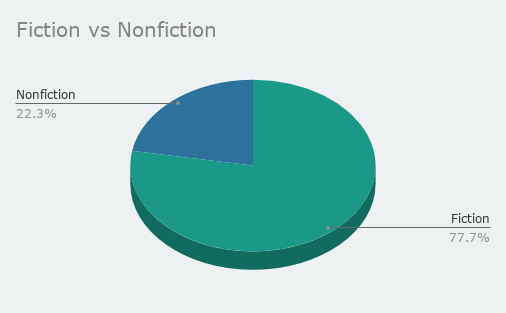
I read 77.7% fiction to 22.3% nonfiction. This is in line with 2019, where I read almost 80% fiction. I definitely noticed that when the pandemic first hit, it was easier to read nonfiction than fiction.


My format percentages also are within 1-2 degrees of where they were in 2019. I would have thought I read more eBooks in 2020 because of the lack of libraries in my life, but these were balanced by an increase in reading books I already owned (for once!) and purchasing new books.


I read almost entirely books for adults. 

My form numbers aren't that interesting, 70% prose, 7%ish for poetry, essay, and short story, and sprinklings of the rest. I'm reading about 50% general fiction.


Just like last year, half my reads are review copies. Some are in print, some are audiobooks, but that isn't broken down in this chart. I used the library 3% less, and I'm surprised that didn't go down more! I guess that goes to show how much I use the libraries' digital content options.

I'm starting to feel disappointed there aren't more obvious changes for 2020, which felt so different. Perhaps reading routines keep me sane. I still gave more books 4 stars than any other rating, still read 14.8% in translation, and still read more women than men, about 25% queer authors/characters and 25% bipoc authors/characters (some of these might intersect).

Next year I'm going to try to track who recommended a book to me, which authors were my first time, and who knows what else!


Friday, January 1, 2021

Reading the Middle East in 2020

I've been slowly traveling around the world in my reading since 2012, trying to read a book from every country, prioritizing books from an author born/living in that country, set in that country, whenever I can. 

I started focusing on specific regions in 2015 and that has been a fulfilling direction. Here's the run down of the past few years:
Asia 2019
Canada and Alaska 2018
Borderlands 2017
Africa 2016
Oceania 2015
Around the World continuing efforts 2014
Turkey 2013
Around the World wrap-up 2012
 

If you go to my profile, you can look at my books and search by title or view the shelves by location (all of these are under "Location-CountryName.") This has become quite the recommendation spot because I often add TBR books to these shelves as well.

This year I focused on the Middle East, trying to finish all the countries I hadn't yet read while deepening my reading in countries I had read books from. The only country I was not able to cross off my list is Bahrain - there really aren't any novels or good quality books from there translated into English; there is one novel set in Bahrain by an English author - The Meeting Point by Lucy Caldwell. I may read it some day but it's not really fulfilling my plans... perhaps I'll have to give in and use reads like this for some of the places if I'm ever going to "finish" this project. (Spoiler alert: I don't believe I'll ever finish!)

I started out by collecting the books I had on hand, and of course I collected more along the way. Because I had such limited access to libraries this year, I focused on what I had on hand first. Several of the book subscriptions and egalleys I requested fit right in, even if they weren't on my initial list. I used interlibrary loan only once, which is very atypical for me, and read a lot of library eBooks. And I hunted down and purchased a few obscure titles for countries that are hard to find.

Here are the physical books I still have on hand that I read:


But here are those that I still didn't get to! Some of these aren't ownvoices authors, which I tried to prioritize, and some are countries I'd already read. Still, at some point I'll need to decide if I should keep and read these titles or just let them go. (If you have opinions, I'm open to feedback):


Since so many were eBooks or eARCs, I'm so glad Goodreads has cover images that you can view in a grid, so all I needed to do was take a few screenshots to show you all the great books I read set in or from the Middle East just this year.


For planner people, I also tracked this challenge in my Passion Planner using a technique I borrowed from a user I can no longer locate in Instagram - she used to be called fruitylemonade (let me know if you know this person and they've just changed names!) The items below are supposed to look like books. I didn't have quite enough colors and then read a few books in Egypt and hadn't included it but should have. And I didn't have a plan for books set multiple places, of which there were quite a few! I have another idea for tracking next year, so stay tuned.


Remember that reviews can be found on my Goodreads, linked above.

Iran
The Blind Owl by Sadegh Hedayat
Home is a Stranger by Parnaz Foroutan
My Part of Her by Javad Djavahery
Then the Fish Swallowed Him by Amir Ahmadi Arian
To Keep the Sun Alive by Rabeah Ghaffari

Iraq
Children of War by Deborah Ellis
IraqiGirl: Diary of a Teenage Girl in Iraq

Israel
The Book of Longings by Sue Monk Kidd
The Memory Monster by Yishai Sarid

Jordan
Mother of All Pigs by Malu Halasa

Kurdistan
Daughters of Smoke and Fire by Ava Home
The Experiment of West-Kurdistan by Zaher Baher
A Small Key Can Open a Large Door by Strangers in a Wilderness

Kuwait
The Bamboo Stalk by Said Alsanousi

Lebanon
Beirut Won’t Cry by Mazen Kerbaj
Oranges in No Man’s Land by Elizabeth Laird

Oman
Celestial Bodies by Jokha Alharthi

Palestine
The Beauty of Your Face by Sahar Mustafah
The Inheritance by Sahar Khalifeh
Track Changes by Sayed Kashua
A Woman is No Man by Etaf Rum
You Exist Too Much by Zaina Arafat

Qatar
The Girl who Fell to Earth by Sophia Al-Maria

Syria
Alligator and Other Stories by Dima Alzayat
The Book Collectors by Delphine Minioui
Death is Hard Work by Khaled Khalifa

United Arab Emirates
Temporary People by Deepak Unnikrishnan

Yemen
Hurma by Ali Al-Muqri
Yemen: What Everyone Needs to Know by Asher Orkaby

Multiple or Unnamed
The City of Brass by S.A. Chakraborty (fantasy)
Guapa by Saleem Haddad
Headscarves and Hymens by Mona Eltahawy
Home edited by Samer Abu Hawwash
How to Feed a Dictator by Witold Szablowski
Our Women on the Ground edited by Zahra Hankir
Travels with a Tangerine by Tim Mackintosh-Smith

Wednesday, January 1, 2020

2019 Reading by the Numbers

This year, I used the Book Riot 2019 Reading Log to track my reading in addition to using Goodreads. The built in charts and graphs allowed me to see at a glance data that used to take me hours to compile in previous years. Huzzah! The Book Riot 2020 Reading Log is available now and I highly recommend it - you can just use the parts that work for you. For instance, I don't log books I DNF, or at least I didn't in 2019, but might do that this year as an experiment. (This is not a paid advertisement, by the way, just a tool that works for me!)

Overall, I read 305 books that I logged in 2019. I read another set of books for my duties as a member of the Over the Rainbow Booklist Committee but since I don't publicly rate those, I didn't find it useful to include them in the log if I planned to share it, which you know I did.

Some celebrities think end of year booklists are bullshit, but I persist. Sharing what I read is the greatest joy in my life, but I also have goals that I like to see coming to fruition through carefully kept data. (Those who know Gallup strengths, and know mine, would not be shocked.)

So the first piece of data is pretty simple, fiction vs. non-fiction. I'm not surprised that fiction is almost 80% but my book club and some reading challenges keep me dipping into non-fiction.

The format is at just a little over 50% digital (and by digital, Book Riot means eBook; my audiobook listening is exclusively digital as well, but I only used "audio" for them.) I think the number of eBooks I read has a lot to do with the number of ARCs I read, since most of them are digital. I'm actually pleased that I read 10% audio, as I wouldn't have thought it was that high.

Age is not so surprising at 3% YA, one title total that is "middle grade," because I mostly read books for adults.
I read a lot of ARCs. A lot! This 50%ish number includes eBooks and physical books. But I also am using my libraries heavily - my academic library where I work, the statewide academic library consortium, interlibrary loan when I need something outside the state, and my public library system. The library number also includes all digital books I get through library subscriptions, largely Hoopla but also Libby, RB Digital, and the occasional academic eBook title.

Next is the gender of the author. The last few years I'd read about 50/50 male/female with a sprinkling of multi-author or non-binary authors. Last year female dominated male. This year that trend continues, with a higher number of non-binary authors.
More about the author - whether or not they are a Person of Color. Why does this matter? I suppose I want to make sure I'm not just reading white people. I don't do well in tracking the #ownvoices column of this spreadsheet so I won't include it, but they are also interested in knowing if a book containing a person from a specific community is written by an author also in that community. I wasn't sure if I should only include it for race and ethnicity or also sexuality, etc., so I found it more straightforward to look at these numbers for now. Some of what helps my number in this category is the reading I do for my Around the World challenge, and Women in Translation Month.
There is also an option to track LGBTQ+ authors. I definitely have a greater awareness of works in this category because of my committee role, but sometimes feel awkward going in search of this information if I don't know it already. It is absolutely possible that I missed some queer authors because I didn't think to check, or they do not include that information in their biographies.

Just like the author matters, the characters matter too. Full disclosure: I edited the labels of the next two graphs, because the spreadsheet asks to select if the main character is a person of color or a queer character, so I did not include gay best friends or a token character on the sidelines. (The graphs originally made it look like it was differentiating between books having any characters of color or queer characters, and I didn't look at it that way.) We want centrality, we want focus.
I've never tracked either of these categories before so I will just list them here for comparison with next year. I definitely believe in reading diverse books.

So what kinds of books am I reading? First we can look at form. With 80% fiction it's no surprise that I'm almost 60% novel but how about 8.5% poetry? Awesome.

When it comes to genre, general/contemporary is king (I put most poetry in this category too.) A few years ago, I was running 18-24% science fiction and fantasy so that number is lower, but I'm not surprised by it. I'm pleased by almost 12% memoir as it is one of my favorite forms, and probably my memoir focus in November is largely to blame. This year I read more romance than I ever have before, and it shows!
A few numbers I don't really need graphs to show - I read 14% books in translation and give most books 4 stars.

Page number wise, I'm guilty, I will read four 200-300 page books before I'll tackle the 400+ page book. I wish I could get past this feeling! That said I did read a few mighty tomes this year, just not a lot in comparison.
And these monthly numbers are a bit deceiving. I may have read more in April, but that's total number of books, not pages. And April being poetry month, well, I might have read a lot of short ones.
I'm not sure how accurate these final figures will be, as I'm often reading multiple books at a time and I'm not sure how the data can account for that, but for comparative purposes:

Average days per book5.931147541
Average pages per day196.28
Average books per month25.50
Average hours per day0:43:58

So it's working well to track this information. Which categories do you think I should track that I haven't? What do you track, and how?
Saturday, December 31, 2016

2016 Reading by the Numbers

I already posted my list of top reads from 2016, but here is the rest of it! Between Goodreads and all my extra shelves I create, I track quite a bit of data that I personally find interesting.

Around the end of December, Goodreads users get greeted by their year in review, automatically generated. These numbers are actually a bit high because it includes the books I abandoned, since I track those too. But they are close.


In 2015, I read 244 books and 65,186 pages. So in one year I increased by roughly 38% in each way of counting, accounting for the handful of abandoned books which shouldn't count but do. I may find a new way to keep track of abandoned titles in 2017. My Read in 2016 shelf says 327 books, which sounds about right.

Last year I read about 50/50 male/female authors; this year my numbers skewed more to female, at about 58%. This isn't the only diverse category I'm interested in but I feel strange tracking authors for other things. Just know that I have been reading widely and diversely and feel pleased that this list is not just all dead white men.

Format is always interesting to me. This year I read 188 (56%) books in print, 125 (37%) in eBook, and 24 (7%) in audiobook. That makes about 2 audiobooks a month. I used to only read library and review copy books in eBook but now that I have a Kindle Paperwhite, that accounts for some increase. I really love reading on it, and it has been a help when I travel. A large amount of the audio and eBooks I read are review copies, and overall I read 109 review copy books this year, accounting for 32% of the books I read, so almost one third. I request review copies, and it is a rare day where I will blindly accept an offer (so please don't get any ideas.) I go looking for specific titles and stick with those.

Other technological shifts that changed some of how I read included learning about Hoopla through the public library (with audiobook and eBook downloads) and the Serial Reader app, which distributes daily content of classics in eBook format. While those were not a huge percentage of the books I read (and they are accounted for in the above format breakdown), this was the first year I read using either of those methods.

I read a lot of books because of award lists. In 2016, that broke down this way:
Baileys Prize - 4
Dylan Thomas - 4
Giller Prize - 1 
Man Booker - 9
Hugo - 3
National Book Award - 6
Nebula - 3
Pulitzer - 2
Tournament of Books - 2

My book club alliances have shifted slightly, and I need to keep better track of books I read because of various groups in Goodreads and Litsy, but here is what I kept track of:

International Center Book Club (in-person) - 9
League of Extraordinary Dorks - 1
Sword and Laser - 6
Misfit Readers - 2
Postal Book Group - 5

And here is a hodgepodge list of various genres and subgenres that I track because I'm interested in getting back to them easily. Some of them I looked at percentages too, just out of curiosity, so will include those when relevant. I felt like I read less science fiction and fantasy this year but it was actually slightly more than last year. I love that 11% of my entire reading list was of translated works. Those were the two surprises.

Africa2016 - 38 (11%)
Around the World - 60
Banned Books - 3
Biography and memoir - 23
Books on Books - 5
Cold Weather Islands - 12
Creative Non-Fiction - 13
Cults & Communes - 4
Graphic novels and comics - 10
Poetry - 39 (12%)
Post-apocalypse and dystopia - 9
Romance - 17
Science Fiction & Fantasy - 43
Secret Agents & Detectives - 4
Short Story Collections - 19
Southern - 8 (this may be low, not sure I caught all of them)
Spooktober - 5
Translated - 36 (11%)
Travel Writing - 7
YA - 17

Jenny's Best Books of 2016

I talked about most of my top books of the year on Episode 075 of the Reading Envy Podcast. But at a glance, it's not easy to figure out which are my picks, and I have a few more I want to mention. Bear with, bear with. I read 337 books in 2016 and so many were fantastic. These are not the only good reads but the cream of the crop.

Many of my favorite reads were books translated into English.


The First Wife: A Tale of Polygamy by Paulina Chiziane
The Vegetarian by Han Kang
Forty Rooms by Olga Grushin
The Story of a New Name by Elena Ferrante


Five of my favorite titles were poetry anthologies, three that came from my Africa 2016 reading. The last three were given to me as review copies but I wish I had them on my shelf with their beautiful artwork, especially the chapbook collections. Those are going on my shopping list for 2017. 


Ark by Ed Madden
Physical by Andrew McMillan
New-Generation African Poets (tatu) ed. By Kwame Dawes
New-Generation African Poets (nne) ed. By Kwame Dawes
The January Children by January Elhillo


Two titles were from award lists - one won the Pulitzer and the other was shortlisted for the Man Booker (while winning other awards.) Both took place partially in Asia, both were excellent reads.


The Sympathizer by Viet Thanh Nguyen
Do Not Say We Have Nothing by Madeleine Thien

 
Three titles, all very different from one another, all had one thing in common - a very strong female voice, and cold weather islands. Different genres, different islands, but unforgettable.

 
Pond by Claire-Louise Bennett
Generation Loss by Elizabeth Hand
The Outrun by Amy Liptrot


One book lingers without a grouping, but I have to include it. An Instagram friend tells me I will find his other books just as memorable and I can't wait. This is a great read about marriage and identity, as true now as it was in 1975.