(Disclaimer: A friend challenged me to review Ulysses in the style of Ulysses, and what better way than to mimic Molly's soliloquy, the last section of the novel? Forgive me, this may not actually work).
Yes because I really have been finished with the book for some time despite that I have not yet said anything about it probably because it is so overwhelming to try to summarize or sound half-way smartpantsed about without wanting to hold everyone back and say wait I think I need to read it over again at least the good bits but I'm not sure I can even remember what they are since they are embedded among so many other parts that really wouldn't make the good bits good if they weren't also there but how can I isolate them when they stuck out for silly reasons like the word fogfagcloud just making me start and say James Joyce! you are such a rebel and then thinking he probably wouldn't appreciate that the parts I appreciate aren't his grand sweeping attempts at intellectual comparison or historical sensibility but rather the characterizations of people who simply don't see enough to ever understand each other and persist in patterns well that's just life anyway and don't we all have our own at least the rest of us don't have authors following us around to report on our bodily functions and internal dialogue at least I would hope not but if that happened I think I'd prefer a life like Molly Bloom where the only time you see me I'm in a bed being waited on and possibly contemplating sordid activities that really I'm overdue for considering the circumstances and really who could blame me anyway since everybody has been proven to be so imperfect oh my water is almost gone and I will feel only slightly guilty sitting here at this restaurant in my writing group because I did pay for a salad that was vinegarcheesewater and it isn't as if there is a multitude waiting for my table anyway after all there are three of us all at our laptops looking very intently at our writing and although I had originally planned to outline a novel for once before going into national novel writing month for the sixth year I've never in my life planned ahead for something I'm writing so why should I start now after all I'm really a much better reader than writer even if I keep hearing interviews with authors where they claim that the reason they went into writing was because of their love for reading but I love books and that doesn't make me any good at it and I don't have any idea what should happen between an idea and its actual production and anyhow I'm not sure I'd ever want to really share anything I've written considering that I have no control over my characters and end up writing stalkerthrillers when I intended to write a love story or magicalfoodierealism when I wanted to write something postapocalyptic but that's okay since I can't go dark enough and without war and death postapocalyptic landscapes are just boring deserts anyway but I suppose that's better than a boring dessert isn't it funny how one letter can completely change a word now I wanted to talk about Ulysses which I now will only pronounce YOU-liss-ease since that is how the reader on the audio book says it and it is kind of like how half the faculty where I work say reSEARCH while I intentionally keep saying REsearch since I hate the idea that anyone would ever think I was pretentious but oh hey what other people think of me is none of my business right I love that sentiment but I have to keep saying it until I believe it but maybe I can at least say what I liked about YOUlissease because some of it has really stuck with me in the last week I loved the ending what a surprise since so much of the novel seemed to marginalize and whorify women no big surprise for a novel from that period but then hearing or reading or hearing the reading of what Molly had in her mind was good in the kind of way where you laugh in surprise at something that is great but unexpected and to hear her wander between talking about the size of male members and wanting to know why men want women to see them naked and what woman hasn't mused over the same silly part of life and isn't it an inside joke of sorts that all women share but to know it was written by a man who had seemed rather clueless up until then was a pleasant surprise and while I think he misunderstood how bodily cycles work because if it worked the way he was thinking she would have spent an entire week on the suddenchamberpot and it kept pulling me out of the narrative but that's okay because I think he really did such a surprising take and I wonder why I don't hear about it more except that I don't think many people actually make it to the end and maybe half the people who act as if they've read Ulysses really haven't kind of like that scholarly article I read that summarized a story and was so completely wrong to anyone who had read it and I wrote the editor of the journal what must have been their four hundredth e-mail about the matter and yet he sent me an appropriately shamefaced and apologetic reply but you never do expect scholars to do such blatant violations of academia and I hope that person was shamed out of the profession how could they ever teach their students anything if they are unwilling to do something as simple as read what they are writing about I'm not sure but I do know that James Joyce would never scrimp on scholarship since he felt the need to try to incorporate every bit of anything he has ever learned into the mighty tome of Ulysses and I'm certainly glad I read it although I do wonder how many times I'd have to go back through before I could ever feel like I remembered everything that was important and I'm so very glad I did it in audio form since listening to the streams of consciousness and soliloquy and random living fantasy worlds somehow settled into a more makingsensical form while I listened and that man that just walked by reeked of pot I hope he isn't driving that truck very far tonight you know I keep reading books that shame my lack of mythological knowledge but I just can't bring myself to sit down and read books on mythology despite being recommended volumes that look as if they are quite good because I've never been one to absorb information in encyclopedia form and so many authors have somehow internalized these characters and gods in such a way that they breathe with them create with them morph them into new and exciting beings while I'm still trying to figure out what is going on and Joyce is the only one who seems more enamored with the humans within the myth than the gods although really he is taking The Odyssey an epic poem and not really a myth I guess and I just had to turn my headphones down although I do love pop music from Scandinavia like Lykke Li I just keep listening to that one song over and over I guess the difference between some of my obsessive tendencies in music listening especially ooh and list making and Joyce's is that Joyce chooses to air his out by forming them into a narrative somehow and while I recognize the genius required in it is strikes me rather like some of the post-tonal music of the late 20th century where you can appreciate it on the page and admire the intricacies without wanting to hear it and is that just a delay in appreciation or is it really not worth listening to I feel you can argue either side and nobody really knows and nobody can win and whoops I just rocked out to the song forgetting people could see me and I suppose that is the danger of a soliloquy and Molly'd better be careful the end except of what comes next well now I have a billion books to read but I'm still drawn in by Dubliners and I wonder what my next mighty tome will be who knows if you've made it this far maybe you can offer a suggestion.
Showing posts with label ulysses. Show all posts
Showing posts with label ulysses. Show all posts
Wednesday, September 21, 2011

Friday, September 16, 2011
Ulysses Chapter 16 - Eumaeus
Two chapters in two days? I think I'm more inspired on the downhill climb. I actually read this chapter in the public domain edition on the Kindle instead of listening to the audio. I'm not sure if this chapter is just more straight-forward than the others, or if I'm finally getting the rhythm of Joyce, but I felt like it was fairly easy to read and that I didn't need much of it explained to me. It must be the former, because Joyce has no rhythm. Every section and chapter changes!
In Eumaeus, Bloom has led Dedalus from the brothel and they are looking for a cab, but finding none, are slowly making their way through late-night Dublin. They end up at a bar that serves them coffee, where they meet an alleged sailor as well as one of Dedalus's young acquaintances. I hesitate to use the word "friend" with Stephen, because even the people who would typically be his friends don't seem to do a very good job of it. In fact, Bloom learns throughout the conversation that Stephen hasn't had anything to eat in two days. Booze, yes. Food, no.
Throughout their conversation, which is refreshingly clear of prostitutes, visions, and play-acting, Joyce seems to be illuminating the differences between the two men. These seem to start with work ethic, where Bloom seems to think that your morality and ethnic/religious background shouldn't matter if you work hard, and Dedalus is still clinging to the beliefs he waxed poetic on in The Portrait of the Artist as a Young Man - artistry being priority one, or priority only, really, and despite the fact that he hasn't had any food to eat and doesn't have any place to stay, his belief in that idea is still dictating his actions.
I particularly love the interchange between Bloom and Dedalus on identity coming from work or something else.
I've peeked ahead a bit, and it looks like Chapter 17 is a question and answer dialogue type section between Bloom and Dedalus, I think once Bloom has him back at his house. I'll probably read that in the print too, because it might be easier going. However, I also peeked ahead to Chapter 18, and it looks like a few run-on sentences make up the entire thing, so it will be back to the audio for the finish!
In Eumaeus, Bloom has led Dedalus from the brothel and they are looking for a cab, but finding none, are slowly making their way through late-night Dublin. They end up at a bar that serves them coffee, where they meet an alleged sailor as well as one of Dedalus's young acquaintances. I hesitate to use the word "friend" with Stephen, because even the people who would typically be his friends don't seem to do a very good job of it. In fact, Bloom learns throughout the conversation that Stephen hasn't had anything to eat in two days. Booze, yes. Food, no.
Throughout their conversation, which is refreshingly clear of prostitutes, visions, and play-acting, Joyce seems to be illuminating the differences between the two men. These seem to start with work ethic, where Bloom seems to think that your morality and ethnic/religious background shouldn't matter if you work hard, and Dedalus is still clinging to the beliefs he waxed poetic on in The Portrait of the Artist as a Young Man - artistry being priority one, or priority only, really, and despite the fact that he hasn't had any food to eat and doesn't have any place to stay, his belief in that idea is still dictating his actions.
I particularly love the interchange between Bloom and Dedalus on identity coming from work or something else.
"...I suspect, Stephen interrupted, that Ireland must be important because it belongs to me."And then later on:
"We can't change the country. Let us change the subject."Stephen is so entrenched in his beliefs, at this point he doesn't even seem interested in debating them with Bloom, who represents the older parental figure that he has tried so hard to get away from.
I've peeked ahead a bit, and it looks like Chapter 17 is a question and answer dialogue type section between Bloom and Dedalus, I think once Bloom has him back at his house. I'll probably read that in the print too, because it might be easier going. However, I also peeked ahead to Chapter 18, and it looks like a few run-on sentences make up the entire thing, so it will be back to the audio for the finish!
Thursday, September 15, 2011
The Circus of Circe - Section 15 of Ulysses by James Joyce
As this is a discussion of a chapter fairly deep into Ulysses, it may contain spoilers.
I'm certain half of what has been written about James Joyce has been written about the section called Circe in Ulysses. I don't even know where to start. In this point of the story, it is past midnight, and Bloom has followed Stephen Dedalus into the redlight district in Dublin, concerned because of how drunk he is. Somehow, despite never really being around him, he has declared himself his protector.
Then the crazy starts. There are actual events going on - he really does go into a brothel, the women there really do charge him for things, Stephen really does try to talk philosophy to two sailors who are going to beat him up, and Bloom really does end the chapter watching over Stephen's passed out body.
Most of the chapter, however, is focused on a swirling fantasy world, mostly in Bloom's head, but some of it belongs to Stephen as well. It is impossible to explain. Both the reality and the fantasy are thrown at the reader at the same time, and the entire segment is written like a play, with named speakers and actions in parentheses. In fact, this would be the most clear chapter in Ulysses (since most of it lacks any quotation marks or "he said-she saids") were it not for the simultaneous events. Hugh Kenner, on his chapter on Circe inJames Joyce's Ulysses: Critical Essays , includes a chart in the appendix that lays out what is actually going on alongside Bloom's vivid imagination. I pledge never to mock a scholarly chart or graph again!
Some of it is obviously fantasy, imagination, or daydream. For instance, all of the sudden, deceased people from Bloom's life, as well as younger versions of people he currently knows, show up for a trial of his character. It reminds me of the Wandering Rocks chapter, where Bloom is moving throughout the city and coming across a lot of minor characters; I believe most of them show up here, even the taxi driver. The trial and defense seem to serve the purpose of Bloom dealing with the guilt he has about various sexual deviances (in his view), and culminates in an exposure of his failings as a husband. Close to when he is leaving the brothel, he has this exchange (BELLO is really BELLA, but she changes genders during the daydream):
I don't know how Ulysses ends, but I suspect Bloom may have made some kind of decision about needing to step up with Molly during this long night. I'm not sure. I guess that is what I hope, but I might be thinking along too modern of a vein. Instead, he puts all of that aside to deal with Stephen, who is so past drunk he is not watching out for his money or safety. He can still recite Yeats, though. At least he is well-educated.
What do the scholars say? There is a deep-seated desire to compare this to other writers, I think to make it seem less inaccessible. Blamires spends a lot of time in comparison with Shakespeare, Gilbert discusses Flaubert (a connection that means nothing to me at this point in my own scholarship), and Kenner manages to throw in Shakespeare, Flaubert, Eliot, and Dickens. Not to mention the connection to the Odyssey, of course, one must never forget that, and Joyce certainly hasn't with his very obvious and frequent animal references, particularly equating the women to pigs. Ah, thanks Joyce, pleasant comparison.
This section includes a touching moment where Bloom has a vision of his deceased son, Rudy, and he has been somewhat of an elephant in every room from the beginning. It is not long to the end. See you on the other side!
I'm certain half of what has been written about James Joyce has been written about the section called Circe in Ulysses. I don't even know where to start. In this point of the story, it is past midnight, and Bloom has followed Stephen Dedalus into the redlight district in Dublin, concerned because of how drunk he is. Somehow, despite never really being around him, he has declared himself his protector.
Then the crazy starts. There are actual events going on - he really does go into a brothel, the women there really do charge him for things, Stephen really does try to talk philosophy to two sailors who are going to beat him up, and Bloom really does end the chapter watching over Stephen's passed out body.
Most of the chapter, however, is focused on a swirling fantasy world, mostly in Bloom's head, but some of it belongs to Stephen as well. It is impossible to explain. Both the reality and the fantasy are thrown at the reader at the same time, and the entire segment is written like a play, with named speakers and actions in parentheses. In fact, this would be the most clear chapter in Ulysses (since most of it lacks any quotation marks or "he said-she saids") were it not for the simultaneous events. Hugh Kenner, on his chapter on Circe inJames Joyce's Ulysses: Critical Essays
, includes a chart in the appendix that lays out what is actually going on alongside Bloom's vivid imagination. I pledge never to mock a scholarly chart or graph again!Some of it is obviously fantasy, imagination, or daydream. For instance, all of the sudden, deceased people from Bloom's life, as well as younger versions of people he currently knows, show up for a trial of his character. It reminds me of the Wandering Rocks chapter, where Bloom is moving throughout the city and coming across a lot of minor characters; I believe most of them show up here, even the taxi driver. The trial and defense seem to serve the purpose of Bloom dealing with the guilt he has about various sexual deviances (in his view), and culminates in an exposure of his failings as a husband. Close to when he is leaving the brothel, he has this exchange (BELLO is really BELLA, but she changes genders during the daydream):
BLOOM: Ten and six. The act of low scoundrels. Let me go. I will return. I will prove...
BELLO: As a paying guest or a kept man? Too late. You have made your secondbest bed and others must lie in it. Your epitaph is written. You are down and out and don't you forget it, old bean.
Joyce, James (2009). Ulysses (p. 543). Public Domain Books. Kindle Edition.
I don't know how Ulysses ends, but I suspect Bloom may have made some kind of decision about needing to step up with Molly during this long night. I'm not sure. I guess that is what I hope, but I might be thinking along too modern of a vein. Instead, he puts all of that aside to deal with Stephen, who is so past drunk he is not watching out for his money or safety. He can still recite Yeats, though. At least he is well-educated.
What do the scholars say? There is a deep-seated desire to compare this to other writers, I think to make it seem less inaccessible. Blamires spends a lot of time in comparison with Shakespeare, Gilbert discusses Flaubert (a connection that means nothing to me at this point in my own scholarship), and Kenner manages to throw in Shakespeare, Flaubert, Eliot, and Dickens. Not to mention the connection to the Odyssey, of course, one must never forget that, and Joyce certainly hasn't with his very obvious and frequent animal references, particularly equating the women to pigs. Ah, thanks Joyce, pleasant comparison.
This section includes a touching moment where Bloom has a vision of his deceased son, Rudy, and he has been somewhat of an elephant in every room from the beginning. It is not long to the end. See you on the other side!
Wednesday, September 14, 2011
Hoopsa! Boyaboy, hoopsa! - Chapter 14 of Ulysses
Episode (Chapter) 14 of Ulysses , Oxen of the Sun, is one of those ideas that sounded better in theory than in practice. I'm pretty sure all authors struggle with these. It comes right before a crazy-frenetic chapter that I'm excited to finish and talk about, but this one was a struggle.
On a very basic level, without the usual mythological references and literary timeline modeling, gives us the first time Bloom and Stephen Dedalus speak to each other in the novel. They cross paths many times, and Bloom knows Stephen's father, but this is their first actual encounter. Bloom goes to the hospital to look in on the friend who has been in labor for three days. During this time there Dedalus and his friends have the kind of spirited discussion about issues of morality and ethics concerning birth that only men in their 20s who have never had to make decisions about people they care about can have. Seriously, I don't always care much for Stephen.
However, that wasn't enough for Joyce. Oh, no. He decided to use this chapter as a homage to the many styles of writing that come from his own literary heritage, from medieval religious texts all the way through to present day pentecostal revival (or is it just advertising? hard to tell) style. I might mention that unless this is pointed out to you, it is impossible to know that this is what he is doing. He had to spell it out to his own peers, and there are several letters that have lasted that allow current scholars to understand it. Would it have been obvious if he hadn't ever done this? I'm not sure. In some ways, by this point in the novel, the reader has to have already given him or herself over to the wave of sometimes-ridiculous, sometimes-nonsensical, sometimes-baffling patterns. I think it is even harder when you're listening.
It makes me think of my experience reading Moby Dick, actually, when I'd be reading along about Ishmael and his Polynesian bunkmate, when all of the sudden Melville would throw in a chapter on whale biology or the history of the harpoon. I question my experience as a reader. Is this greatness? Is this what makes it a classic? Or do books get categorized this way because people assume that something they struggle to read makes it "good?" It is as if James Joyce wanted to encapsulate everything he loves about Irish history, mythology, current events in religion and politics, and his own education into one novel, while also writing in a way that nobody else ever have. Well James, you win!
I'm finally into "Circe," which is supposed to be the pinnacle of the entire work.
, Oxen of the Sun, is one of those ideas that sounded better in theory than in practice. I'm pretty sure all authors struggle with these. It comes right before a crazy-frenetic chapter that I'm excited to finish and talk about, but this one was a struggle.On a very basic level, without the usual mythological references and literary timeline modeling, gives us the first time Bloom and Stephen Dedalus speak to each other in the novel. They cross paths many times, and Bloom knows Stephen's father, but this is their first actual encounter. Bloom goes to the hospital to look in on the friend who has been in labor for three days. During this time there Dedalus and his friends have the kind of spirited discussion about issues of morality and ethics concerning birth that only men in their 20s who have never had to make decisions about people they care about can have. Seriously, I don't always care much for Stephen.
However, that wasn't enough for Joyce. Oh, no. He decided to use this chapter as a homage to the many styles of writing that come from his own literary heritage, from medieval religious texts all the way through to present day pentecostal revival (or is it just advertising? hard to tell) style. I might mention that unless this is pointed out to you, it is impossible to know that this is what he is doing. He had to spell it out to his own peers, and there are several letters that have lasted that allow current scholars to understand it. Would it have been obvious if he hadn't ever done this? I'm not sure. In some ways, by this point in the novel, the reader has to have already given him or herself over to the wave of sometimes-ridiculous, sometimes-nonsensical, sometimes-baffling patterns. I think it is even harder when you're listening.
It makes me think of my experience reading Moby Dick, actually, when I'd be reading along about Ishmael and his Polynesian bunkmate, when all of the sudden Melville would throw in a chapter on whale biology or the history of the harpoon. I question my experience as a reader. Is this greatness? Is this what makes it a classic? Or do books get categorized this way because people assume that something they struggle to read makes it "good?" It is as if James Joyce wanted to encapsulate everything he loves about Irish history, mythology, current events in religion and politics, and his own education into one novel, while also writing in a way that nobody else ever have. Well James, you win!
I'm finally into "Circe," which is supposed to be the pinnacle of the entire work.
Friday, September 9, 2011
Figuring out Ulysses in Charts and Graphs

This is a great example of over-the-top analysis- the chart of where all the characters in Wandering Rocks are, and at what time. I'm not sure it really adds much to the understanding of the chapter, as the reader is not living the book in the same time as the characters, but I loved how they made such an effort to include the chart, even putting in special fold-out pages.
Later on, the chapter including the Citizen has a listing of all the references and what they "might" mean.
Charts! Graphs! Whatever it takes!
Thursday, September 8, 2011
Checking in on Ulysses
 |
| Photo courtesy of Laurie | Liquid Paper on Flickr |
I'll divide my random thoughts by chapters! At this point I have just finished reading Nausicaa. I am also now pronouncing Ulysses as "YOU-liss-ease" in my head, thanks to the podcast I mentioned before.
I am certainly glad I read A Portrait of the Artist as a Young Man
 prior to reading Ulysses, although I wish I'd read them closer together. I'm also wishing I'd read Dubliners
 first too, as some of the minor characters in Ulysses are from those short stories. While their backgrounds may not be crucial to understanding the main story in Ulysses, I feel like Joyce is working on the assumption that the reader at least is familiar with them. Most of the time I am blissfully ignorant until one of the companion books schools me on what I missed. I downloaded the public domain version and will probably read it after reading Ulysses, just to fill out the story a bit. Reader beware! If you've always wanted to read Ulysses, read everything else Joyce ever wrote first. You might even want to tackle his letters, if you can find them, since apparently they are the inspiration for the letters Bloom himself writes!
Chapter 10: The Wandering Rocks
This is the chapter that I last wrote about, at only about 1/3 of the way in. It spirals through a bunch of characters, and is supposed to feel like waves swirling around and crashing into rocks, maybe dangerous, maybe harmless, and I think Joyce succeeds here.
Chapter 11: Sirens
Bloom goes back into a bar, and we follow him on an afternoon shopping trip. I think the whole chapter is pretty ironic because he is obsessing over his wife's lover AS HE IS BUYING STATIONARY TO WRITE TO HIS LETTER WRITING MISTRESS. Whatever. At the same time, I'm fond of the chapters that jump us into Bloom's head.
Chapter 12: Cyclops
I had to reference the companion books to understand this one, for sure. There is an unnamed person "Citizen" who has a very staunch opinion about issues of homeland and nation, and clearly does not think Bloom should consider himself first and foremost "Irish." I remember earlier discussions of the loss of the Irish language within Ulysses, and even in the time of the novel many of these concepts are starting to be popularly viewed as archaic.
The part that I really paid attention to was the discussion of love. Bloom explains love as being the "opposite of hatred," and the citizen mocks him for his concept of "universal love," which starts in on a whole discussion of the many versions of love. Some of it makes me think of Martin Luther King Jr., but perhaps Ulysses and King just share the same source material.
And then is this little sentence - "Off he pops like greased lightning." I was in the car when I heard this, and I had a lyrical kneejerk response and shouted "Grease lightning, go grease lightning." Completely irrelevant to anything, but I thought you might enjoy how my mind wanders as I listen to an audio book.
Chapter 13: Nausicaa
My original intent was to say I really enjoyed this chapter, that it felt like a break from the political/economic/religious commentary of some of the other chapters, but then all the critics disparage it and say Joyce intentionally wrote it like a fluffy womens magazine. Hmm. Maybe I like womens magazines. It was refreshing to hear from a woman's perspective, as Joyce tends to stick inside of male heads. Gerta is charming, in how she is focused on her ribbons, but can still tell the power that she has.
The language in this chapter, and in how Joyce can capture a moment within the moment, is so much better in audio than it would be read in print. I dare you to try reading it in print without wanting to hear it out loud. It is much more evident what is going on when you hear the section about the fireworks read aloud. I was... surprised at how far Joyce took it. Bloom is a little bit of a creeper, actually (I feel more compassionate toward him than that... we know from earlier chapters that he and his wife have not been intimate since their son died). I wonder if anyone was bothered in the historical reading of Ulysses by the synchronous imagery of Gerta giving Bloom a peek and the Catholic ecstatic visions.
This chapter also includes some moments of misogyny that really stuck out. The most memorable is when Bloom is ruminating about drunk husbands:
"Husband rolling in drunk, stink of pub off him like a polecat. Have that in your nose in the dark, whiff of stale boose. Then ask in the morning: was I drunk last night? Bad policy however to fault the husband. Chickens come home to roost. They stick by one another like glue. Maybe the women's fault. ... Always see a fellow's weak point in his wife."Right, wives. If your husband is out boozing, you must be the weak link! Ha.
After Gerta leaves, Bloom is spent, also emotionally. He starts reflecting back on the early days of romance between he and Molly:
"So it returns. Think you're escaping and run into yourself. Longest way round is the shortest way home."A fitting conclusion to the Nausicaa chapter, really. I've peeked ahead and the next chapter is epic in length and coverage, but is the last one sitting in between the infamous Circe and my experience, so I'm going to get right on that!
Tuesday, August 30, 2011
Halfway through Ulysses!
I hit about 47% through listening to Ulysses, and I got stalled, big time. Part of it was catching up on the companion books that I finally got from the library, and part of it was realizing I didn't remember hardly anything from the second part (of 4) that I'd tried listening to in audio.
At least I now know I can't absorb audio books in the following situations:
I started to develop a routine. Listen to one chapter in Ulysses, then read the companion books about that chapter - first Blamires, then Gilbert, then Hart/Hayman. The only trouble is that neither the audio book nor the Kindle version (based on the public domain editions) have the modern chapters with titles. The audio book has chapters but they are arbitrary and split by time, not contents (argh!). So I've been juggling multiple versions of this thing, including a few online versions that have the named chapter titles.
I'm getting closer to the chapter that every scholar talks about or alludes to - Circe. Halfway through Ulysses, at least in the audio book, is about 1/3 of the way through Chapter 10 - The Wandering Rocks. It is strange to post halfway through a chapter, but here I am!
What will follow are probably what seem like random observations, or little bits that stuck out to me. I'll leave the food observations out, but I'm taking note of those to maybe make a Ulysses meal at the end. Why not?
"'A father,' Stephen said, battling against hopelessness, 'is a necessary evil.'"
This is from the epic chapter debating Shakespeare to infinity. There does seem to be a struggle between Stephen and his father, and a greater separation than I remember there being in Portrait. Of course, Stephen is 3-4 years older now, and has lost his mother in that time.
A few other things I learned about that chapter from the helper books. Both of these observations come from the chapter on Scylla and Charybdis written by Robert Kellogg in the James Joyce's Ulysses: Critical Essays volume. The very first sentence says:
I also had said I was puzzled why Joyce, over and over, calls one character the "Quaker librarian." Apparently students who couldn't afford to go to Trinity College or some of the other universities would still meet at the National Library. Not just students, but intellectuals of all sorts, would gather and the "Quaker librarian," Thomas W. Lyster, would lead the conversation. Interesting. It also makes me feel better as a reader to realize I wasn't supposed to just accept that this long, very deep, very detailed conversation on Shakespeare, etc., just materialized. Rather it came out of a tradition, something Stephen and his friends probably do on a regular basis.
It may still be my least favorite chapter, but I feel more approving of the young scholars. They like to learn, and enjoy discussing their knowledge. I really can't fault anyone for that. And in the end, Joyce got one huge laugh out of me when Buck Mulligan is stumbling around and announces, "I smell the pubic sweat of monks!" He always manages to pull out something overly descriptive. Or maybe that is just Mulligan's way.
It should all be downhill from here, right? A new friend in GoodReads directed me to a very interesting blog/podcast by Frank Delaney, called Re: Joyce. He is taking little bits of Ulysses and explaining them in detail. The podcasts are short, but it seems like this might take years. YEARS! He is the most eloquent man in the world, according to NPR, so I would bet he has something to say. I'm subscribing to see what I can learn.
At least I now know I can't absorb audio books in the following situations:
- Grocery shopping (such a shame!)
- Right after work
- While working on anything else (knew this already)
- During any time my brain is spinning, like lately with the semester starting
I started to develop a routine. Listen to one chapter in Ulysses, then read the companion books about that chapter - first Blamires, then Gilbert, then Hart/Hayman. The only trouble is that neither the audio book nor the Kindle version (based on the public domain editions) have the modern chapters with titles. The audio book has chapters but they are arbitrary and split by time, not contents (argh!). So I've been juggling multiple versions of this thing, including a few online versions that have the named chapter titles.
I'm getting closer to the chapter that every scholar talks about or alludes to - Circe. Halfway through Ulysses, at least in the audio book, is about 1/3 of the way through Chapter 10 - The Wandering Rocks. It is strange to post halfway through a chapter, but here I am!
What will follow are probably what seem like random observations, or little bits that stuck out to me. I'll leave the food observations out, but I'm taking note of those to maybe make a Ulysses meal at the end. Why not?
"'A father,' Stephen said, battling against hopelessness, 'is a necessary evil.'"
This is from the epic chapter debating Shakespeare to infinity. There does seem to be a struggle between Stephen and his father, and a greater separation than I remember there being in Portrait. Of course, Stephen is 3-4 years older now, and has lost his mother in that time.
A few other things I learned about that chapter from the helper books. Both of these observations come from the chapter on Scylla and Charybdis written by Robert Kellogg in the James Joyce's Ulysses: Critical Essays
volume. The very first sentence says:"The soul of a city is its talk. Whether its body is resplendent with avenues or is smudged with laborious grime the vital signs of civic life are verbal: gossip, stories, speeches, and conversations of every sort. The literary artist who would render a city must reproduce its talk. Of no city is this more true than of Dublin, and one of the rarest moments in the fictional history of human talk is 'Scylla and Charybdis,'....."Basically, the part I really had to slog through, the part that interested me in the least, is the very part I am supposed to be appreciating the most, according to this guy. I think it was reading this essay that made me go back and try listening to it one more time.
I also had said I was puzzled why Joyce, over and over, calls one character the "Quaker librarian." Apparently students who couldn't afford to go to Trinity College or some of the other universities would still meet at the National Library. Not just students, but intellectuals of all sorts, would gather and the "Quaker librarian," Thomas W. Lyster, would lead the conversation. Interesting. It also makes me feel better as a reader to realize I wasn't supposed to just accept that this long, very deep, very detailed conversation on Shakespeare, etc., just materialized. Rather it came out of a tradition, something Stephen and his friends probably do on a regular basis.
It may still be my least favorite chapter, but I feel more approving of the young scholars. They like to learn, and enjoy discussing their knowledge. I really can't fault anyone for that. And in the end, Joyce got one huge laugh out of me when Buck Mulligan is stumbling around and announces, "I smell the pubic sweat of monks!" He always manages to pull out something overly descriptive. Or maybe that is just Mulligan's way.
It should all be downhill from here, right? A new friend in GoodReads directed me to a very interesting blog/podcast by Frank Delaney, called Re: Joyce. He is taking little bits of Ulysses and explaining them in detail. The podcasts are short, but it seems like this might take years. YEARS! He is the most eloquent man in the world, according to NPR, so I would bet he has something to say. I'm subscribing to see what I can learn.
Wednesday, August 24, 2011
Reading Ulysses - Getting Unstuck
There is nothing worse than rhetoric for the sheer joy of it, when it isn't your subject of interest. I've listened to chapter 9 - Scylla and Charybdis - at least three times, because I keep zoning out and thinking of other things. Anything else, really.
Blamires sums it up pretty well:
Okay, I confess. I'm not even halfway interested in the multiple layers of meaning going on with Shakespeare, his real life, his characters and their potential real lives, and only partially interested in what this has to do with the characters in Ulysses. At this point I'm going to soldier through it and see what is on the other side.
Part of it is that my attention is distracted. Classes started today so it is hard to turn my mind off and just listen to an audio book when my to-do list is a mile long, and there are more mindless books to zip through, and I have been. This may not have been the right part of Ulysses to tackle when attacked by the many-headed monsters of my own life! At least I partially grasp that reference, eh?
One silly detail sustaining and repeaking my interest from time to time is the character fondly referred to as the "Quaker librarian." Why is his Quakerness so important that it must be always used? I'll look for an explanation of that before moving on in the text.
I'm not worried that I wont finish. Most mighty tomes have draggy parts. I keep reminding myself that at least it isn't whale anatomy like in Moby Dick!
Blamires sums it up pretty well:
The menace is created by a wordy encounter between Stephen Dedalus and a group of talkative scholars in the National Library. Whirlpool images occur several times, associated with the swirling depths of Platonist metaphysics in which Russell and the librarians are whirled. -Harry Blamires, The New Bloomsday Book
Okay, I confess. I'm not even halfway interested in the multiple layers of meaning going on with Shakespeare, his real life, his characters and their potential real lives, and only partially interested in what this has to do with the characters in Ulysses. At this point I'm going to soldier through it and see what is on the other side.
Part of it is that my attention is distracted. Classes started today so it is hard to turn my mind off and just listen to an audio book when my to-do list is a mile long, and there are more mindless books to zip through, and I have been. This may not have been the right part of Ulysses to tackle when attacked by the many-headed monsters of my own life! At least I partially grasp that reference, eh?
One silly detail sustaining and repeaking my interest from time to time is the character fondly referred to as the "Quaker librarian." Why is his Quakerness so important that it must be always used? I'll look for an explanation of that before moving on in the text.
I'm not worried that I wont finish. Most mighty tomes have draggy parts. I keep reminding myself that at least it isn't whale anatomy like in Moby Dick!
Wednesday, August 17, 2011
James Joyce Playlist
I haven't posted on Ulysses for a few days. I'm busy catching up on the commentary reading, to get back to where I'd left off in my listening, and I will go back to it once I have.
In the meantime, I decided to try out Spotify, the newest music sharing, listening, and discovery service to the United States (it has been popular in the UK for ages). I have become a big fan of cloud music, and have accounts in Rhapsody and Mog, so was curious about this one.
Then one of my colleagues posted a link to the Spotify Classical blog, which culls out classical content from Spotify and puts it into playlists. As I scanned through recent posts, I saw one on the Music from Works of James Joyce. I was almost as happy as when I listened to Haunted while reading House of Leaves
 . I love when there is a connection between books and music, probably because music is almost a more familiar language to me. Those connections make both elements more memorable. I will definitely listen to this playlist from time to time as I read Ulysses!
Disclaimer: I do not get paid anything by Spotify. In fact, in the strangeness of having a free account with them, my playlists keep getting interrupted by weird commercials for music way outside the genre of the music I'm listening to.
In the meantime, I decided to try out Spotify, the newest music sharing, listening, and discovery service to the United States (it has been popular in the UK for ages). I have become a big fan of cloud music, and have accounts in Rhapsody and Mog, so was curious about this one.
Then one of my colleagues posted a link to the Spotify Classical blog, which culls out classical content from Spotify and puts it into playlists. As I scanned through recent posts, I saw one on the Music from Works of James Joyce. I was almost as happy as when I listened to Haunted
while reading House of Leaves. I love when there is a connection between books and music, probably because music is almost a more familiar language to me. Those connections make both elements more memorable. I will definitely listen to this playlist from time to time as I read Ulysses! Disclaimer: I do not get paid anything by Spotify. In fact, in the strangeness of having a free account with them, my playlists keep getting interrupted by weird commercials for music way outside the genre of the music I'm listening to.
Thursday, August 11, 2011
Ulysses Reading Companions

These three books contain all the answers to the James Joyce universe. Okay, probably not, but they have been eye-opening to me. I just picked them up yesterday and sat down to see what they had to offer tonight. They are each different, and I will keep reading at least two of them as I read and listen to Ulysses by James Joyce.
I have read each book's information on Part 1 of Ulysses - Telemachus, Nestor, and Proteus; and in that short time have figured out what each book's strength is and what order I want to use them in. I tend to be methodical like that, but the patterns help my brain wrap around this very overwhelming text. On the one hand, I could just decide to sit back and enjoy what I'm hearing, with an occasional laugh about a cheese sandwich, but that seemed like a failing somehow. I don't mind the extra work, and while I won't absorb everything these books say, each has really had something to offer towards the context or interpretation of what I was reading.


On the top of the pile is The New Bloomsday Book, by Harry Blamires, is probably the most straight-forward of the three. I currently have the first edition, just called The Bloomsday Book, but the 3rd edition is on its way, and I doubt it is very much different. Blamires does a good job of summarizing the action of the story, but rarely includes any actual quotation of the text. I can see someone just reading this and not getting what makes Ulysses great, because the prose and rhythm of the writing is part of what sets the book apart.
Even better, each chapter starts out with an explanation of the parallel section of The Odyssey. I mentioned before that I read The Odyssey over ten years ago, but the brief contextual work Blamires does is enough to bring another level of understanding to what Joyce may have been thinking or planning.
So far, he has really emphasized the symbolism of water = fertility. I'm not sure I see it, but he really wants me to believe that at the very least, Stephen Dedalus is using and understanding it in that way. Blamires does seem to focus on the symbolism of the scenery and items in the story - the shaving bowl, the ocean, the bridge; and then finds their counterpart in the Odyssey. I don't mind this. I'm not sure Joyce always intended these things, but it is an interesting perspective.
I also enjoyed the parentage chart at the beginning, of both the Bloom and Dedalus families. That would have been helpful the first time through chapter 4 or so, when I didn't understand who Simon was.
In my companion reading, I start with the Blamires. It fills me in on details that I may have missed in the strange consciousness stream of Dedalus and Bloom by summarizing the story, and helps get me reoriented.

 Second in the pile, and second in my companion reading, is James Joyce's Ulysses: A Study
 by Stuart Gilbert. I will start out by openly admitting that I skipped to page 101 in this book, which is where the companion chapters start. The first 100 pages of the book are an introduction to Ulysses. I can't decide if I should read them now or wait until I am done. A lot of "introductions" to literature that I have read in the past have spoiled surprises, so I tend to go back to them. Anyone with another recommendation should let me know!
What immediately won me over to Gilbert was that the companion chapter to Telemachus started with discussing Stephen Dedalus in A Portrait of the Artist as a Young Man
. I still have bits of that in my head from high school, and it helped link the character into Ulysses in a way my brain had not accomplished yet. A reminder of Dedalus's complete and utter idealism, partnered with a dissatisfaction in his own life. There have been constant references back to Portrait, serving as contrasts the Stephen of then vs. the Stephen of now, particularly since he has had more religious conflict and lost his mother in the meantime. Part of the fun of the Gilbert is that at the beginning of each companion chapter, he includes the scene, the hour, the art, the symbol, and the technic. For Telemachus, for instance the scene: the tower, hour: 8 am, art: theology, symbol: heir, technic: narrative (young). It is a fun exercise but sometimes Gilbert reads like he is stretching the contents to fit within the symbolic structure he has selected. Most of the time it works out okay.
In each chapter, Gilbert provides a summary of sorts, but with frequent quoting and footnoted research that break up the flow of the writing. Sometimes I go back and re-read it, and sometimes I skim and let it float over my head. He even sometimes discusses different translations of the original Greek in The Odyssey and what differences in meaning that would attribute to Ulysses. It can be a bit intense, but I like the combination of the scholarship with the summation. Read right after the Blamires, it is like singing a repeat on an aria (you know, where you embellish it?). It seems to me that if both Blamires and Gilbert zero in on the same passage as being important, I truly should pay attention to it. That helps a lot, more than I expected.

 On the bottom of the pile, and last consulted in my companion reading, is James Joyce's Ulysses: Critical Essays, edited by Hart and Hayman. They took a unique approach and each companion chapter was farmed out to a different scholar, so that they could come at a section from a fresh perspective. Unique, but not always helpful, if I'm being honest. The focus of each scholar is different, and sometimes it feels like they are really stretching some ideas to try to seem more insightful than even this complicated text demands.
 In Telemachus, for instance, Bernard Benstock is talking about the changing narrator, and how the narrator's tone and empathy changes depending on which character is being talked about. That, I could see. He went on to discuss examples of how the words used to describe the characters matched their characterization in tone and roundness... the actual words, and how your mouth forms them. Matching the characters. Wow. I don't know. If Joyce did this, he was a bit obsessive. I like to think that if this is true throughout the book (and I'm not sure it is), it was more of an unconscious zone of mood or tone in writing.
The Proteus chapter was fascinating. It is a hard chapter to read in Ulysses, because even the scholars aren't quite sure what all the little bits of randomness mean or refer to or are directed to. Overarchingly, Epstein, who authors this chapter, tries to argue that Joyce simultaneously exists as Proteus within the story, while writing Dedalus to be him, and that he has done so ever since Portrait:
"...He is beginning to want to know the deathless Proteus by holding fast to all his changing manifestations. He seeks fluid, wavelike forms that will express immutable laws through infinite mutations, the clarity of eternal forms through their opaque but ineluctable modalities. In this chapter he doesn't succeed. Stephen Dedalus never succeeds. Only Joyce will succeed. The chapter, written by Joyce and brilliantly successful, shows us Stephen still in the dark amid the blaze of Joyce's noon."It is an interesting parallel, and Epstein goes on to say that Bloom may embody who Joyce/Dedalus strives to be without knowing it. I guess we'll see.
That is one thing about this companion book that is endlessly frustrating - it is full of spoilers. It assumes you know what happens in the end (wish I hadn't seen that paragraph, because I didn't know!), and everyone wants to draw parallels with what happens in the Circe chapter, which isn't until chapter 15. At this point, I'm looking forward to getting there, because all the scholars are excited about it.
I feel like I have written this as I've been processing what I read this evening, so I hope it isn't too scattered. It is clear that a reader could go down the rabbit hole in comprehending Ulysses, and I hope I haven't gone too far!
Tuesday, August 9, 2011
Reading Ulysses, 25% in
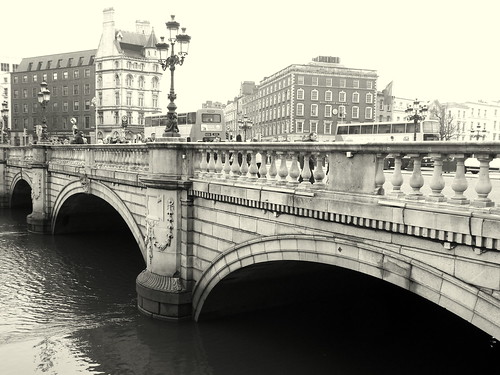
I've been on a bit of an extended weekend and have only done piece-meal listening, but finally made it about a quarter in, which means I'm just about finished with Chapter Eight: Lestrygonians.
So far I have followed Leopold Bloom to the butcher, to the outhouse, to the post office, reading a letter from an erotic penpal of sorts (to a pen name), to a funeral, to a newspaper office, to a bar, across a bridge, and so on. It is pretty funny because since so much of what Joyce wrote is stream of consciousness writing, the activities and dialogue of the characters is interspersed with Bloom's constant internal dialogue, including his distraction by attractive women, fretting about his wife's potential dalliances, his daughter's boyfriend, his mother's death, and so on.
The audio started getting confusing around the time of the carriage ride to the funeral, and I had to go back and look at some character lists. I should have the readers guides in-hand tomorrow, which will help a lot too! Simon Dedalus is Stephen's father, and I don't think it was happenstance that Dedalus Sr. and Bloom share a carriage ride, so they must be connected in some way. There is a long conversation about death, as is expected when heading to a funeral.
Bloom thinks about death more later on. He runs into an old flame who tells him about a woman who has been hospitalized for a difficult birth. He was handed an evangelical tract along the way, and his thoughts go in circles being "washed in the blood" and the cycle of death and life, particularly since back then so many women and children died in or around childbirth. His own son only lived a few days.
I left Bloom eating a cheese sandwich.
Little tidbits I liked:
-The headlines interspersing the story in chapter.. 7, or 6, hard to tell with the audio. "Onehandled adulterer" gets repeated several times.
-When Bloom is contemplating who can own the river, Joyce throws in another poetic description of water, which he seems to love.
"His eyes sought answer from the river and saw a rowboat rock at anchor on the treacly swells lazily its plastered board."
-At one point he is thinking about what would catch someone's eye in an advertisement, and says
"Smart girls writing something catch the eye at once. Everyone dying to know what she's writing."
I liked that for different reasons, since some of my friends are still writing real letters, but it also points to how women keep showing up in his thoughts.
-Random funny bit:
"Mayonnaise I poured on the plums thinking it was custard."
I lost track of why/how that came up. Plums come up multiple times though. Do they mean something? This is one idea I'll look up in the companion books!
Friday, August 5, 2011
Reading Ulysses, Day 2
Full disclosure - I've been reading a bit of information outside of Ulysses just to understand what is going on, and I downloaded the free Kindle version so that I could go back and re-read bits that stuck out and quote them correctly.
I mentioned before that the only Joyce I had made it all the way through previously was A Portrait of the Artist as a Young Man , and the very first part of Ulysses
 actually features the same character, and was published four years after Portrait, although I'm not sure how much time has passed to Stephan Dedalus. The first three chapters of Ulysses are referred to as the Telemachiad, and chronicle Dedalus with his friend Buck Mulligan, and then follow Dedalus as he teaches, meets with an advisor, and then one long chapter where he's just ... thinking. Stream of consciousness, in multiple languages. I'm not going to lie and say that was easy to follow!
Part of the problem for me as far as reading comprehension is that Joyce wrote this as a parallel to the original Odyssey. Have I ever read that? I remember doing group projects having to do with the Odyssey in seventh grade, including a really fun radio play version that my group wrote and performed, but that was the last time I read anything close to the Odyssey. That would have been twenty years ago. I'm worried that I'll miss the connections, that I won't "appreciate" it as it was meant to be understood, but I'm just letting that go and trying to enjoy what I can.
There are a few bits of the Telemachiad that stuck out to me, which I will reproduce here:
Some of the language is descriptive, in a way that only young men could make it.
"A great sweet mother? The snotgreen sea. The scrotumtightening sea." (Mulligan talking about the ocean to Dedalus).
"History, Stephen said, is a nightmare from which I am trying to awake."
(To Mr. Deasy)
"To learn one must be humble. But life is the great teacher."
(Mr. Deasy to Stephen)
"Reading two pages apiece of seven books every night, eh? I was young. You bowed to yourself in the mirror, stepping forward to applause earnestly, striking face. Hurray for the Goddamned idiot! Hray! No-one saw: tell no-one. Books you were going to write with letters for titles. Have you read his F? O yes, but I prefer Q. Yes, but W is wonderful. O yes, W..."
This last one is a good example of the Dedalus stream of consciousness that goes on for a while, but also made me laugh and think of C by Tom McCarthy, and I wonder if he chose it because of this passage (especially considering that most of his novel is a shoutout to other novels).
After the last chapter of the Telemachiad, the novel practically restarts and begins the morning with Leopold Bloom. I have more questions than answers at this point. Is there a connection between Bloom and Dedalus? Why bother with Dedalus at all?
I suppose I may find this out eventually. For now, I will content myself to hear about Bloom's breakfast preparations and toilet ruminations, which is how I last left off.
I mentioned before that the only Joyce I had made it all the way through previously was A Portrait of the Artist as a Young Man
, and the very first part of Ulysses actually features the same character, and was published four years after Portrait, although I'm not sure how much time has passed to Stephan Dedalus. The first three chapters of Ulysses are referred to as the Telemachiad, and chronicle Dedalus with his friend Buck Mulligan, and then follow Dedalus as he teaches, meets with an advisor, and then one long chapter where he's just ... thinking. Stream of consciousness, in multiple languages. I'm not going to lie and say that was easy to follow!Part of the problem for me as far as reading comprehension is that Joyce wrote this as a parallel to the original Odyssey. Have I ever read that? I remember doing group projects having to do with the Odyssey in seventh grade, including a really fun radio play version that my group wrote and performed, but that was the last time I read anything close to the Odyssey. That would have been twenty years ago. I'm worried that I'll miss the connections, that I won't "appreciate" it as it was meant to be understood, but I'm just letting that go and trying to enjoy what I can.
There are a few bits of the Telemachiad that stuck out to me, which I will reproduce here:
Some of the language is descriptive, in a way that only young men could make it.
"A great sweet mother? The snotgreen sea. The scrotumtightening sea." (Mulligan talking about the ocean to Dedalus).
"History, Stephen said, is a nightmare from which I am trying to awake."
(To Mr. Deasy)
"To learn one must be humble. But life is the great teacher."
(Mr. Deasy to Stephen)
"Reading two pages apiece of seven books every night, eh? I was young. You bowed to yourself in the mirror, stepping forward to applause earnestly, striking face. Hurray for the Goddamned idiot! Hray! No-one saw: tell no-one. Books you were going to write with letters for titles. Have you read his F? O yes, but I prefer Q. Yes, but W is wonderful. O yes, W..."
This last one is a good example of the Dedalus stream of consciousness that goes on for a while, but also made me laugh and think of C
by Tom McCarthy, and I wonder if he chose it because of this passage (especially considering that most of his novel is a shoutout to other novels).After the last chapter of the Telemachiad, the novel practically restarts and begins the morning with Leopold Bloom. I have more questions than answers at this point. Is there a connection between Bloom and Dedalus? Why bother with Dedalus at all?
I suppose I may find this out eventually. For now, I will content myself to hear about Bloom's breakfast preparations and toilet ruminations, which is how I last left off.
Thursday, August 4, 2011
Reading Ulysses, Day 1


I'm sure all of us have mighty tomes we haven't yet read. I've tackled Moby Dick
 , Les Miserables
 , and Anna Karenina
 , but there are still a few I want to get to.
 War and Peace
 is definitely on the list for someday, although I start trying to work up to it from time to time and the translations of the Russian naming conventions just does me in, so I haven't yet faced it. Add to that not knowing much about Russian history, and I worry that I wouldn't get all the context. Infinite Jest
 is still sitting on my shelf at home. I don't think I've even cracked the binding. One of my favorite reader friends keeps telling me all these other post-modern titles I need to read "first." I've been scared away!
 One book that I've started several times is Ulysses (Oxford World's Classics)
. I read A Portrait of the Artist as a Young Man in high school, but the rest of Joyce has eluded me. Ulysses has to be the book I've started and put aside the most often. I know it has greatness inside it. Any review I've read by people who have made it through praise it up and down. The only time I made any progress at all was when I read it out loud; something about the flow of the language just demands it. The only problem with that strategy is that I often read while I'm around other people, and I'm not sure they would appreciate this practice. Last night I finished listening to Wizard and Glass (The Dark Tower, Book 4)
 and went looking for a new audiobook to listen to. I usually listen while I'm driving or cooking, any time where I can devote most of my brain power to just absorbing what I'm hearing. The reviews of the next Dark Tower book were mixed on the audio - the original reader had been in a bad accident and someone else took over, and a lot of people were saying it was better to read the print. I'm one of those people who might choose an audiobook based on the reader, so I wasn't about to listen to one that people who prefer to listen didn't like! I searched and searched, through Overdrive and Audible, for something that really reached out and grabbed me, but I wasn't finding much. (I was hoping for the Talented Mr. Ripley books, since I so enjoyed the Highsmith short stories in audio, but they don't seem to exist).
I started thinking about books that take well to audio, and about accents, and stumbled across two versions of Ulysses. Longer books really make Audible.com credits worth while, because the CDs for them might cost around $100, but the entire book was only 1 Audible credit. There were two versions to choose from, and I listened to previews of both and tried reading reviews of both, but in Amazon, they group all editions of a book together, making it impossible to link a specific review to a specific reader (this is such a bad practice, it hurts my librarian heart). I ended up going with the version read by John Lee
 , because one Audible review said it used the more accepted version of the book (whatever that means, ha!), and his voice was a little easier to listen to. I'm not sure if that will hold out for the long haul, and one reviewer actually said they thought the experience was better at 60% speed, actually slowing down the voice to allow your brain to process the accent and the words.
 Right now I'm listening at real-time speed, and we'll see how that goes. I have only gotten about ten minutes in (you can blame my short commute), but already am enjoying the dynamics between the characters and the description of the landscape. This will be a thirty hour listening commitment, so I will give updates from time to time.
Subscribe to:
Posts (Atom)