Monday, December 27, 2010

Please Help Me Love J. M. Coetzee

Every once in a while, I read a book because I think I should. Maybe an author has been nominated for an award, or wins an award, or keeps showing up on those lists of books you "should" read. So I try.

The first book I read by J. M. Coetzee was Disgrace, and I read it in 2006. To me, it was the epitome of what has almost become an archetype in modern literature - the depressed, amoral, worn-out, male academic. My dislike was severe, I was surprised I finished it. I wondered if it was just because I couldn't identify with it, as a 28 year old who had just finished a graduate degree, at the beginning of her career and quite happily married. Imagine my horror upon discovering that this actually won the Man Booker Prize in 1999! Ha.

For whatever reason, probably the "shoulds," I read Slow Man in 2007. It had actually been nominated for the Man Booker Prize in 2005. It contains a character from a previous book that I have not read, Elizabeth Costello. The main character was similar to the one in Disgrace, to the point that even the other characters in the novel point it out!

"She could not stay with a man who was tired all the time. It was hard enough to hold her own tiredness at bay. She had only to stretch out beside him in the too familiar bed to feel the weariness begin to seep out of him and wash over her in colourless, odourless, inert tide. She had to escape!"

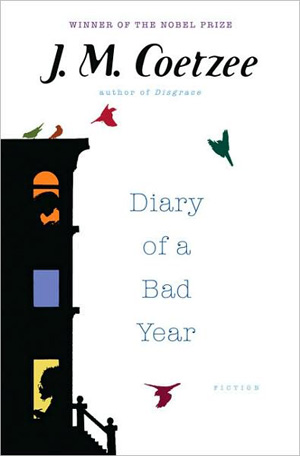
When I was selecting books to read over the long holiday break, I thought maybe I would try giving Coetzee another chance. I brought three of his books home with me - Diary of a Bad Year, Summertime, and Elizabeth Costello. I made it through Diary of a Bad Year, but found it suffered similar issues as the other two. Add to that the tone of it being written in an autobiographical tone (I believe it has even been called autobiographical fiction, a subgenre quite a bit of his work falls under), and the divided writing style, and it was torture.

I read the first chapter of Elizabeth Costello and of Summertime, but just couldn't force myself. I might just call it quits on Coetzee, kind of like I had to do with Brahms as a young pianist, after each reading through of a piece was worse than the one before. Maybe he would mean more to me later on in life. I hope not, because I fear that to identify with him more would be to have lived in misery.

But seriously, what am I missing? I am willing to continue forcing myself to have an open mind.

Tuesday, December 21, 2010

Great House by Nicole Krauss

I finished this book a couple of weeks ago, one of the finalists for the National Book Award for 2010. I've waited to review it for a bit so I could mull it around in my head.

There are heavy themes here, of loss, obsession, and also how they relate to Jewish history and identity. This is far more delicately handled by Krauss than by Howard Jacobson in The Finkler Question, where the characters are always informing each other that they are thinking about their Jewish identity.

When it comes down to it, most of the stories center around a desk and interweaving versions of loneliness. This is also handled in a subtle way, and in some cases the desk doesn't even show up for a while. It varies in importance, and she crafts interesting characters with unusual tendencies. I was actually sad to reach the end because I was reluctant to let the stories go.

"In life we sit at the table and refuse to eat, and in death we are eternally hungry."

I would give this one 5/5 stars, and recommend reading it.

Friday, December 10, 2010

Why I Didn't Finish

I keep copious lists of the books I want to read, have read, and even the books I have abandoned. I adopted Nancy Pearl's philosophy that life is too short to read a book you aren't into, and in general I give books a good 50 pages, 100 if it has been recommended to me or nominated for an award.

Okay, some books I give fewer than 50, and some I moan that I bothered finishing once I get to the end (Freedom, anyone? I'll quit picking on that book eventually, maybe it will be my New Year's Resolution).

I think the book I was saddest to abandon so far this year was I Hotel by Karen Yamashita. It was one of the finalists for the National Book Award in the fiction category, and it is about my favorite city on earth, San Francisco. It chronicles ten years during the civil rights movement, focusing on different characters and movements in each section. The story is told through prose, poetry, scripts for faux documentaries, and other narrative tricks.

In the first section, I was actually really into it. I liked the characters, I loved how the author incorporated the historical research into it, and I even marked quotations that I liked. ("I've been too busy missing you to be angry" was my favorite, from a poem written on the wall by an immigrant.) But then I got into the second section, and discovered all the characters I had started to grow fond of and interested in had been abandoned for an entirely new set of characters and situations.

I don't want to say there is no overarching plot, because I didn't read until the end to find out if they return. But I had the sense that the characters aren't the point - the city is the point. The city and the themes among those fighting for their rights in the 1960s and 1970s - this is the focus. The characters help to tell the story and then they move on.

I'm still chiding myself for not having enough patience, but around page 215 (see, more than 50 pages) it started to feel formulaic, patterned, and insincere. Life is too short, so I allowed myself to quit.

I actually wonder if it might be better in the context of a history class than read straight through - specific sections paired up with deep looks into different groups of people who settled in the bay area, and their struggles for survival and identity. It might be a better use of the creative presentation of what was a fascinating time in United States history.

Friday, November 26, 2010

National Book Award Reviews - YA Fiction

I think it is a mistake to assume young adults won't notice that a book is preachy just because they are young. I think it is a mistake to award books for being didactic without thinking first if they are enjoyable. In that regard, the National Book Award people made some interesting choices as finalists for what they call the "Young People's Literature" category. Let me just say that to me, the majority of the books chosen for the finalist list were clearly chosen by adults because of what could be learned, not because of how good they were.

Luckily, a few escaped and made it into my first category, the definitely read list.


Dark Water by Laura McNeal was the hardest book on the list to find, but I finally found it from a library in Annapolis, Maryland. At first, I was worried this was another didactic book with a plot thinly veiling a lesson to young people about migrant workers, but it soon shifted into a beautifully love story between a young girl who lives on an avocado farm outside San Diego but doesn't speak Spanish (really?) and an illegal worker who can't speak. The ending is fearless, and I think young girls in particular would be drawn in by this story.


Ship Breaker by Paolo Bacigalupi was a surprisingly enjoyable read. I had read The Windup Girl earlier in the year but enjoyed this one much more. It is about kids who live in a post-disaster future America with prevalent hurricanes and the only way to really make a living is to salvage materials from the ships that regularly wreck on the shore. It is gritty and I really enjoyed it.

The next category are the books that are good, kind of, but read rather preachy for my tastes. Boys and girls, let's open our books to page....


Mockingbird by Kathryn Erskine covers a lot of Very Important Issues - school shootings, dealing with death and loss, Autism Spectrum, etc. The main character, Caitlin, is learning how to make friends while she tries to find closure for her brother's death. I thought it was heartfelt, and I think it might make kids want to try to be more accepting of people who are different than them. But should we have to make them through fictional characters? See, that's the whole issue I have. Apparently enough people believed so, because this book won in the category.


One Crazy Summer by Rita Williams-Garcia chronicles the crazy summer of three sisters who are sent to Oakland to live with their mother shortly after the death of MLK Jr. She turns out to be involved with the Black Panthers, and the girls learn about the movement and explore California. It is more than a little unbelievable, and packages up the time period a little too perfectly, but the oldest daughter is an interesting independent female, which is nice for young people. At least, from an adult's perspective it is.

The last book, I just didn't like.


Lockdown by Walter Dean Myers is a hopeless story about a boy in jail who will probably never escape the system. If I was supposed to get more out of it, I'd love to hear a counterargument. The author is known for working in the juvenile system, but I did not find him to be inspiring at all. Maybe reality isn't. At least it wasn't preachy.

Thursday, November 25, 2010

So Much for That by Lionel Shriver


So Much for That was one of the books selected as a finalist in the fiction category for the National Book Award. They have already picked winners, but I'm still slogging my way through all the finalists.

I previously reviewed Parrot & Olivier in America by Peter Carey, since it was also shortlisted for the Man Booker Prize this year. So Much for That is only the second of the five novels that were finalists for this year's prize in fiction.

The majority of this book is probably the biggest downer I have ever read, and I've read some depressing books! Add that to a swirling prominent preachy thread of the problems with the health care system in the United States, and you have a recipe for a disaster. Most depressing books have me internally begging with the author to just get on with it and to give me my life back. Despite what most critics say, I almost always feel that way about McEwan (except with Solar), and the last Franzen made me feel that way too.

Except. Except, except, except. Shriver writes fearlessly and honestly, with excellently written characters, and this made it interesting and pleasing to read. I read the majority of it in one day.

Sunday, November 14, 2010

Book Review - The Shallows by Nicholas Carr


I remember Nicholas Carr because of an article he wrote back in 2008, Is Google Making Us Stupid?. According to his notes on The Shallows, he actually expanded on the ideas of the article to write the book.

I picked up this book for a variety of reasons. As a librarian who often does information literacy/fluency instruction, I want to learn as much as I can about how students think and process information. We make decisions all the time about materials - do we stick with print or order eBooks? Is an online periodical sufficient? Can we discard our print reference collection? The answers are not always easy. I can't shake Nicholson Baker and his harsh judgment on libraries, ever since reading Double Fold, and that was also in the back of my mind as I read. The Shallows is a clear picture of where information has come from compared to how we tend to access it and use it in the present day.

The other perspective I'm bringing to this is that of a reader, a great lover of the printed page, of holding a book in my hands and shutting out the world. Carr discusses changing attitudes toward reading at great length. People abandoning the idea of reading because the internet makes it easier, because they no longer "have to," or because they are finding entertainment elsewhere.

"We are now seeing such reading return to its former social base: a self-perpetuating minority that we shall call the reading class.' The question that remains to be answered, they went on, is whether that reading class will have the 'power and prestige associated with an increasingly rare form of cultural capital' or will be viewed as the eccentric practitioners of 'an increasingly arcane hobby.'" (108)

The idea of deep reading gets discussed, as well as what it can do for a learner to shut off everything and focus on reading an entire book, rather than living solely in the shallow world of the internet. I also enjoyed the bits about the history of the printed page, and all the prophets of doom throughout the centuries who have wrongly predicted the end of the book.

I think this is a valuable read for anyone interested in how people learn, how technology changes our brains, and the value of reading.

Thursday, November 11, 2010

Literary Blog Hop Week 2 - Most Difficult Literary Work

Literary Blog Hop
This week's question comes from Debbie Nance at Readerbuzz
What is the most difficult literary work you've ever read? What made it so difficult?

I imagine that since it asks "read," that implies actually finishing. Otherwise I'd be talking about how many times I have started-but-not-finished Ulysses by James Joyce. My only strategy with that one is to read it out loud, but I still end up putting it aside for something else. Nothing like a difficult book to get you to develop reader's ADD!

Some books that I've tackled that sometimes are considered difficult, such as Gravity's Rainbow, Les Miserables, and so on - these have been so enjoyable that it seemed completely worth it.

I'm going to choose Moby Dick for my answer to this question. Ah, Melville. I read this along with a group that was reading a chapter a day, and as Moby Dick has 365 chapters, it took a year. If I had read it on my own, I would surely have read it more quickly, so the process itself was a little tedious. I know this is supposed to be one of the great novels of life and death and obsession, and I definitely enjoyed the bits that had interesting characters and plot. Right when I would get into the story, Melville would go off on a tangent and talk about whale biology or the history of the shipping industry. Difficult books might give me reading ADD, but Melville clearly had writing ADD! Revenge, redemption, oh look, there's a pony! It was distracting and I wanted to abandon ship (har har) more than once, just on principle.

At the same time, I think of how many times reading one book has sent me off in search of more information about history or philosophies or people represented within it. Perhaps Melville was doing me a favor by providing all the possible context within the pages of one integrated novel!

As many difficult books as I have enjoyed, I still have several major ones I haven't gotten around to reading. I am trying to decide between War and Peace and Infinite Jest as the book I'll tackle during the winter holidays.